What's New
Alaska’s Housing Shortage: The Factors That Cause It & The Levers We Control
Alaska’s Housing Shortage: The Factors That Cause It & The Levers We Control
Six practitioners on which of Alaska’s housing costs are inherited, and which ones are choices.
ANCHORAGE (08/27/26) — Forum Summary by Ross Johnston, Executive Director
When Shaun Debenham moved his family back to Anchorage two decades ago, he had a plan straight out of the standard playbook: rent an apartment for a year, get reacquainted with the city, then buy a house. The structural engineer, born and raised in Midtown, got as far as the first step before the plan collapsed. There was nowhere he wanted to put his family. What he found instead, in his words, was “all this 80s garbage that I’m not really interested in living in.”
So he started building apartments himself. His company’s Block 96 became the first market-rate apartment building constructed in downtown Anchorage in more than 15 years.
Twenty years after that homecoming, Debenham sat on a Commonwealth North panel with five other people who fight the same problem from different trenches: a state housing finance analyst, the head of Alaska’s tribal housing authority network, Anchorage’s top development regulator, a utility economist, and a nonprofit developer. The question underneath every presentation was the one Debenham’s story poses. Why is the problem he came home to still unsolved?
The afternoon’s answer, assembled six ways: some of it is inherited, like frost, freight, and interest rates. Some of it is chosen.
WATCH THE FORUM RECORDING
A Shortage Without a Boom
Daniel Delfino, Director of Planning and Program Development at Alaska Housing Finance Corporation, opened with the paradox that shadowed the forum.
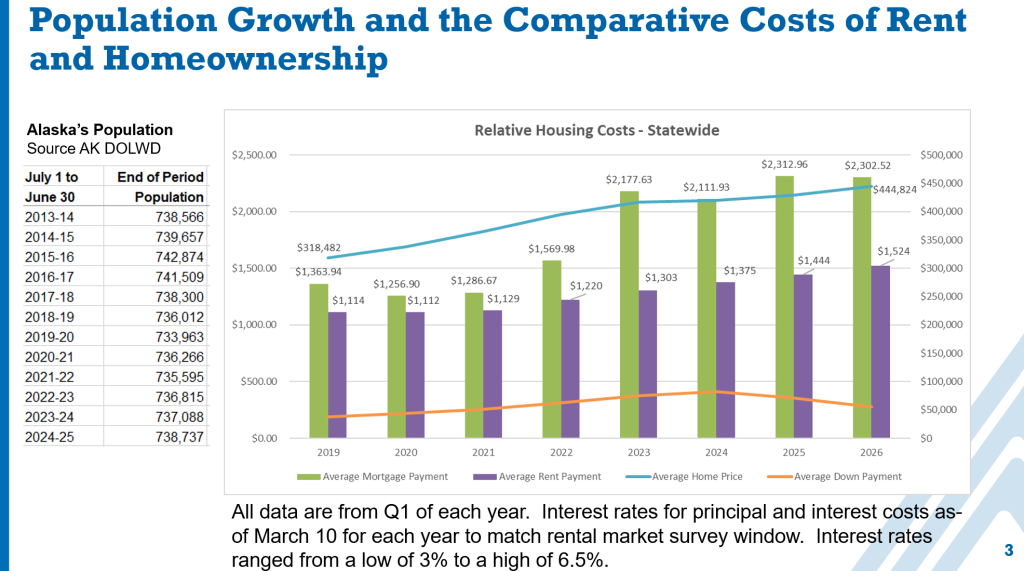
Alaska has roughly the same number of people it had in 2013. The housing market is tight nearly everywhere anyway.
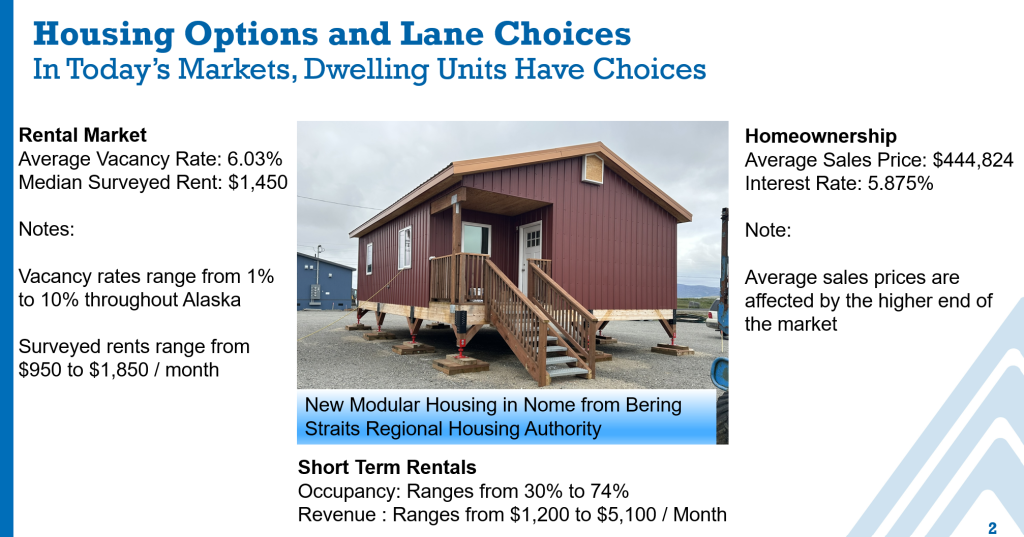
Statewide rental vacancy hovers around 6%, but the average flatters the truth: most hub communities sit below 5%. Median surveyed rent has reached $1,450 a month, up about 30% over the survey period. Homeownership costs rose faster, up more than two-thirds, driven roughly 40% by home prices and the rest by interest rates that climbed from a 3% trough to nearly 6%. The average sales price in AHFC’s lender survey now exceeds $440,000, a figure Delfino cautioned is pulled upward by the high end of the market.
If population isn’t driving the squeeze, what is?
Delfino offered candidates rather than conclusions. Household composition may be shifting. Aging stock is coming offline. Homeowners who locked in 3% mortgages in 2020 and 2021 now face 6% if they move, so some who might have sold are staying put. Is Anchorage’s thin inventory a real estate problem or a rate-lock problem? “It’s an open question,” Delfino observed.
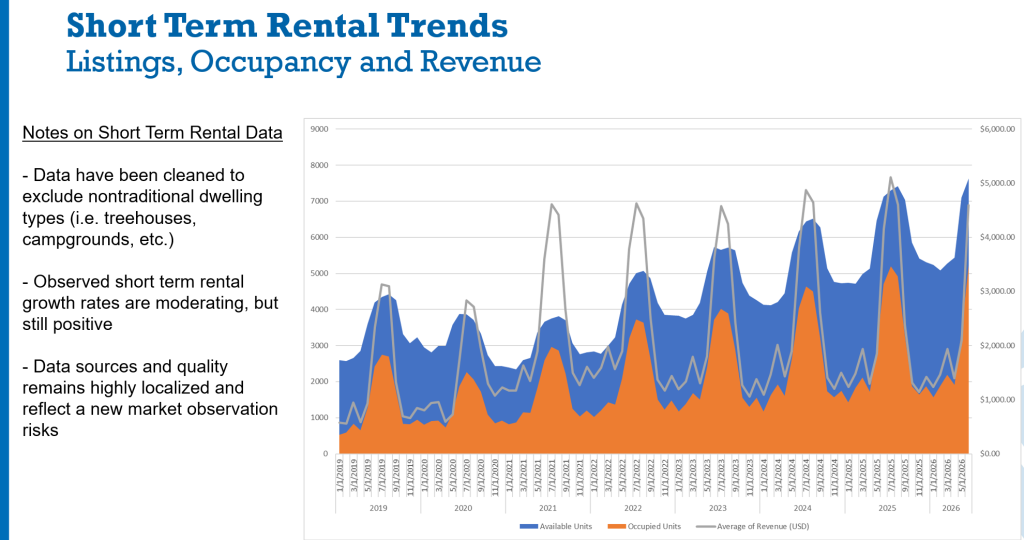
And then there is the newest math: what a dwelling earns as a short-term rental versus a long-term lease. Short-term rentals in the surveyed markets swing from roughly 1,500 occupied units in slow months to more than 5,000 during peak tourism, generating anywhere from $1,200 to $5,100 a month per unit. Set that against the $1,450 median long-term rent and the incentive comes into focus: in peak season, a short-term rental can earn more than three times what a year-round tenant pays. The revenue is volatile, and in the slow months it can dip below a long-term lease. But for some owners, the spreadsheet points away from housing a neighbor and toward housing a tourist. As Delfino put it, “These are the numbers, and the numbers are pointing them in certain directions.”
Less than 1% of Alaska’s land is privately held, and a developable lot can become a rental, a for-sale home, or a short-term rental. The economics does the deciding. “I’m not advocating for one thing or the other,” Delfino noted. “These are the numbers, and the numbers are pointing them in certain directions.”
Asked late in the Q&A about the next three to five years, with $7 to $8 billion in JBER-related investment raised from the floor, Delfino declined to project. He simply restated the arithmetic: vacancy under 5% in the communities where most Alaskans live, average mortgages over $400,000, and thousands of short-term rental units that could swing either direction. “More people need places to live” was as far as he would go.
It was far enough.
The Lost Generation
Griffin Forster, Executive Director of the Association of Alaska Housing Authorities, represents the network of 14 regional housing authorities serving as tribally designated housing entities for 201 tribes under the Native American Housing Assistance and Self-Determination Act of 1996, known as NAHASDA. The Alaska Legislature authorized the formation of RHAs in the 1970s after concluding that no private-sector path to housing existed in much of rural Alaska. Fifty years later, Forster spends much of his time on the phone explaining that reality to people in Washington, D.C. including why a single 2×4 can cost $13 by the time it reaches a village.
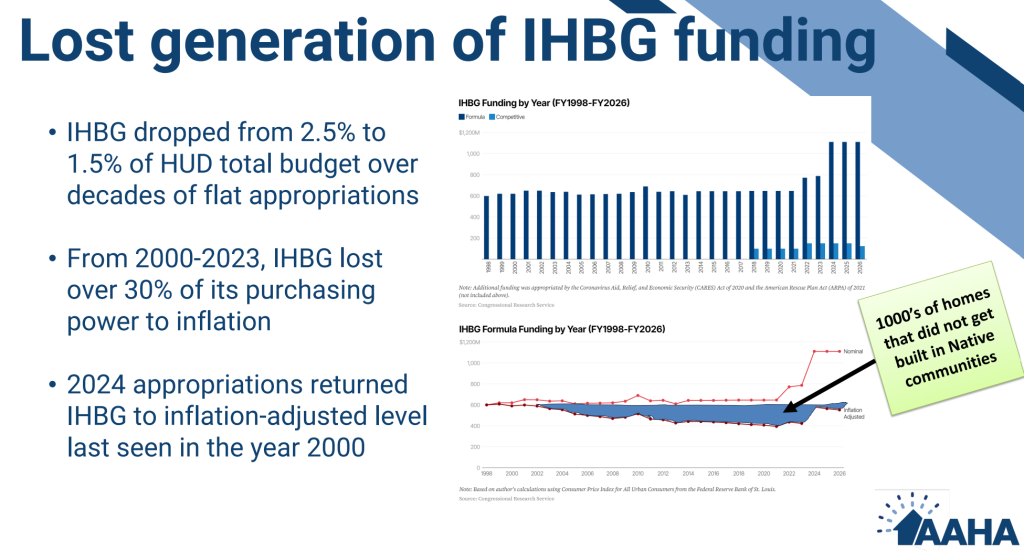
His central exhibit was fiscal. The Indian Housing Block Grant, HUD’s largest investment in Alaska, fell from roughly 2.5% to 1.5% of HUD’s total budget through decades of flat appropriations, losing over 30% of its purchasing power to inflation between 2000 and 2023. The 2024 appropriation, which Forster credited to congressional champions, restored the program only to its inflation-adjusted level from the year 2000. NAHASDA itself has not been reauthorized since 2008, leaving tribal developers to make decade-scale investment decisions with no view of the horizon. The Build America, Buy America Act, part of 2021’s Bipartisan Infrastructure Law, then added compliance obligations with no funding attached.
The gap between those two lines is what Forster calls the lost generation: thousands of homes never built in Native communities. Then he made the abstraction concrete with an aerial photograph.
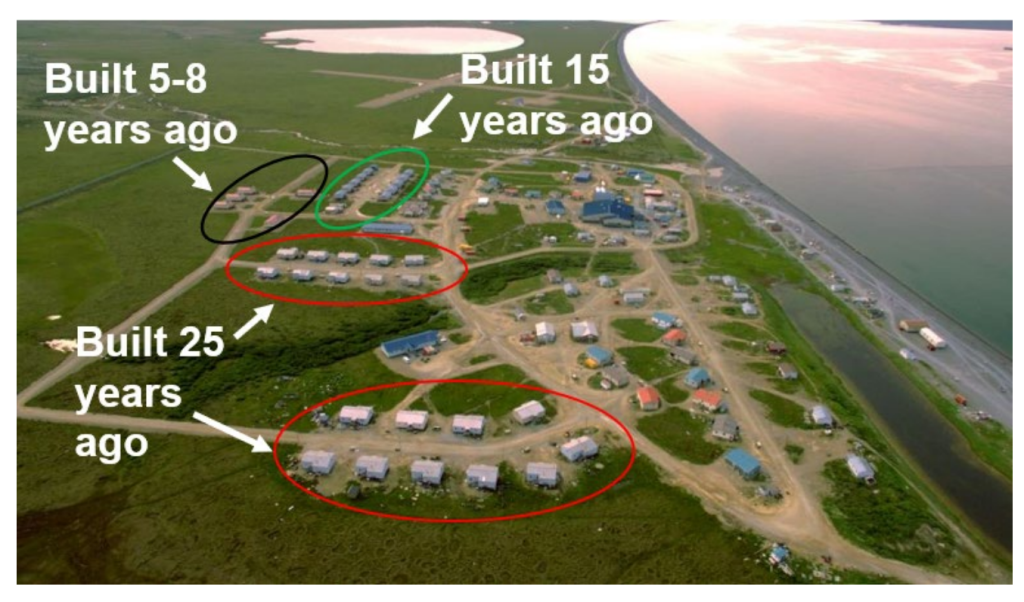
From the air, Brevig Mission looks like a timeline. Twenty homes built 25 years ago, when NAHASDA was new, fill two large circles. Tenhomes built 15 years ago fill a smaller one. The cluster from the last five to eight years holds five houses. “That’s inflation,” Forster observed. “It speaks for itself.”
RHAs are responding with what they control: a leadership pipeline for the next generation of tribal housing professionals, development of shared servicesForster likened to the Costco effect, and innovative project approaches. Two examples were a 25-unit self-help project in Kodiak being built with support from Koniag and RurAL CAP, among others, and a 2024 military training airlift, Operation Arctic Haven,that moved 39 tons of building material to the North Slope at no cost to the housing authority, saving roughly a million dollars in logistics.
Tyler Robinson picked up the thread where RHAs meets its largest city. Cook Inlet Housing Authority is one of Forster’s 14 RHAs, the designated housing entity for Cook Inlet Region, Inc., and about 90% of the tribal members living in its roughly 1,800 apartments come from regions outside Southcentral. Anchorage is the hub. CIHA has spent 52 years building for it.
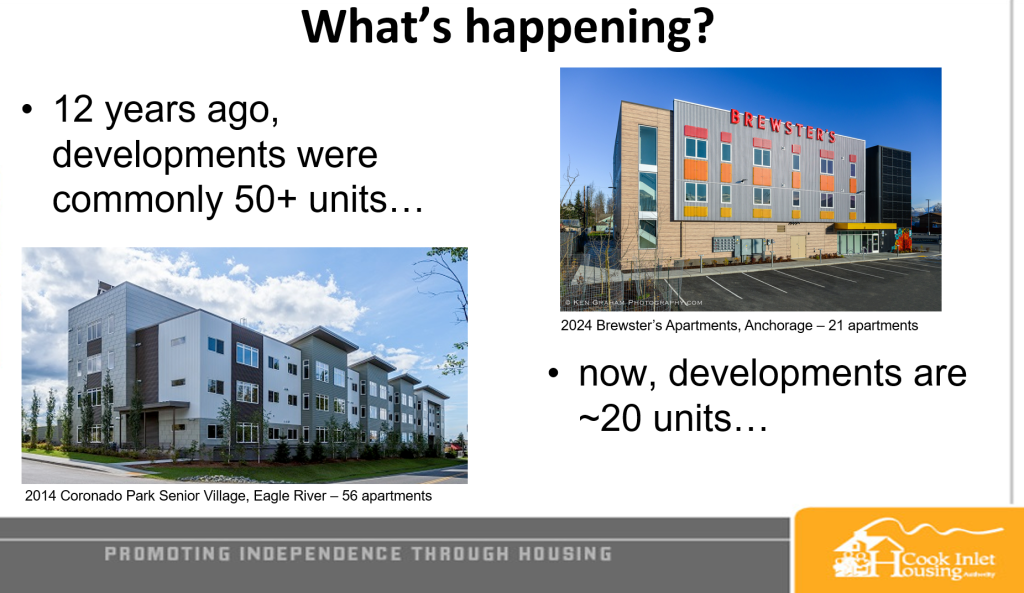
What changed, Robinson argued, is scale. In 2014, a typical CIHA development was 50-plus units in a single phase, like the 56-apartment Coronado Park Senior Village in Eagle River. Today the typical deal is 20 to 24 units carrying most of the same fixed costs, and reaching operational efficiency requires stitching together two or three phases. Borrowing a framework from Atlanta urbanist Eric Kronberg, he sorted the cost problem into five L’s: land, labor, lumber, laws, and loans. Then, reaching back to high school French, he added the sixth that rental developers cannot ignore. Les operations.
On land, he credited the municipality for moving problem properties into productive hands, including a fire-damaged house CIHA is under contract to replace. But land, he pressed, means nothing without infrastructure, and here he offered the afternoon’s starkest pair of numbers. CIHA broke ground this month on a water main extension to serve 40 future homes. The utility’s estimate was around $450,000.
The bid came back at $900,000.
A senior housing project in Wasilla, meanwhile, is on hold over uncertainty about whether the city’s treatment plant has the sewer capacity to serve it. These are not line items. They decide whether projects exist.
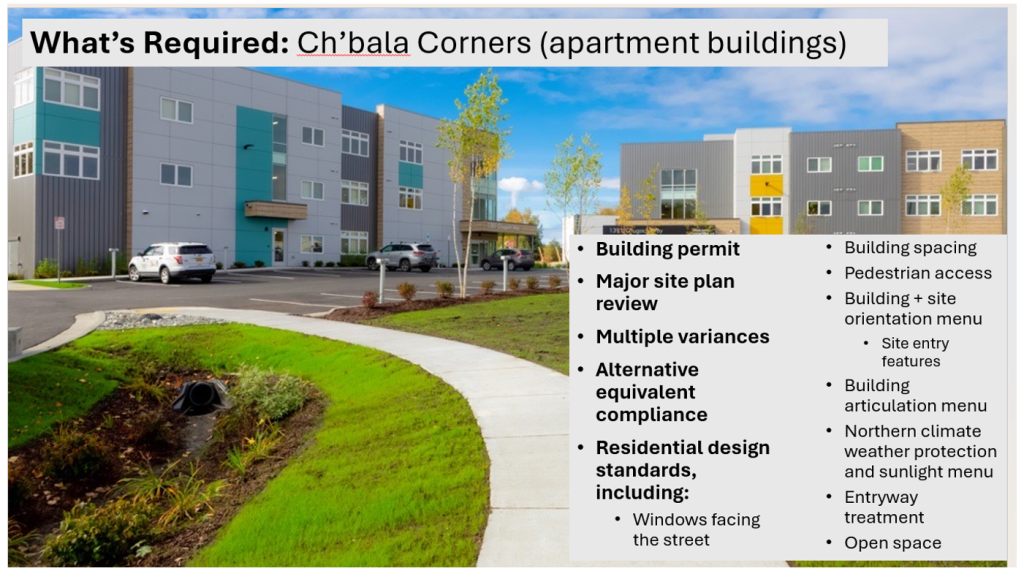
On laws, Robinson put up a slide built around a pointed comparison. If his multifamily buildings had been hotels, the only requirement would have been a building permit. Because they were housing, a menu of design mandates applied.
The comparison drew a question in Q&A: four hotels are under construction in Anchorage while apartment buildings stay scarce, so why? Part of the answer is simply that they are different animals. Hotels are commercial projects on commercial land, answering a tourism market that has kept them feasible in Anchorage in ways multifamily housing has struggled to be for decades. Robinson’s slide wasn’t offered to explain the hotels. It was offered to ask a harder question about the housing: if everyone knew multifamily was already failing to pencil, why did the code add roughly 15% in design-standard costs, a figure Debenham supplied from his own pro formas, to that use type alone? The requirement wasn’t what killed multifamily feasibility. It was weight added to a swimmer already underwater.
The mandate is paused through at least 2028, and Robinson said two CIHA developments are underway a full year early because of the suspension.
He closed with two warnings.
The first came wrapped in an anecdote about why CIHA is studying modular construction: on a project last year, in the January cold, the framing crew walked off the job. A factory floor doesn’t do that.
The second warning was quieter and larger. Robinson said he is not certain CIHA’s affordable portfolio can absorb the natural gas price increases ahead. “I don’t know that we’re gonna be in this business.”
The Price Buried Under the Street
Mark Foster, principal of Mark A. Foster & Associates and a former Alaska Public Utilities Commission commissioner, presented preliminary findings from a Rasmuson Foundation-supported analysis of a cost most buyers never see: utility interconnection.
He began with a market health check, comparing Anchorage to Spokane, a similarly sized regional hub he has benchmarked for years. Before COVID, Anchorage had 426 more monthly home listings.
This summer, Spokane has 1,375 more listings than Anchorage.
“Anchorage is stuck in the doldrums,” Foster observed. “I don’t know the source of the problem, but I know we have a problem.”
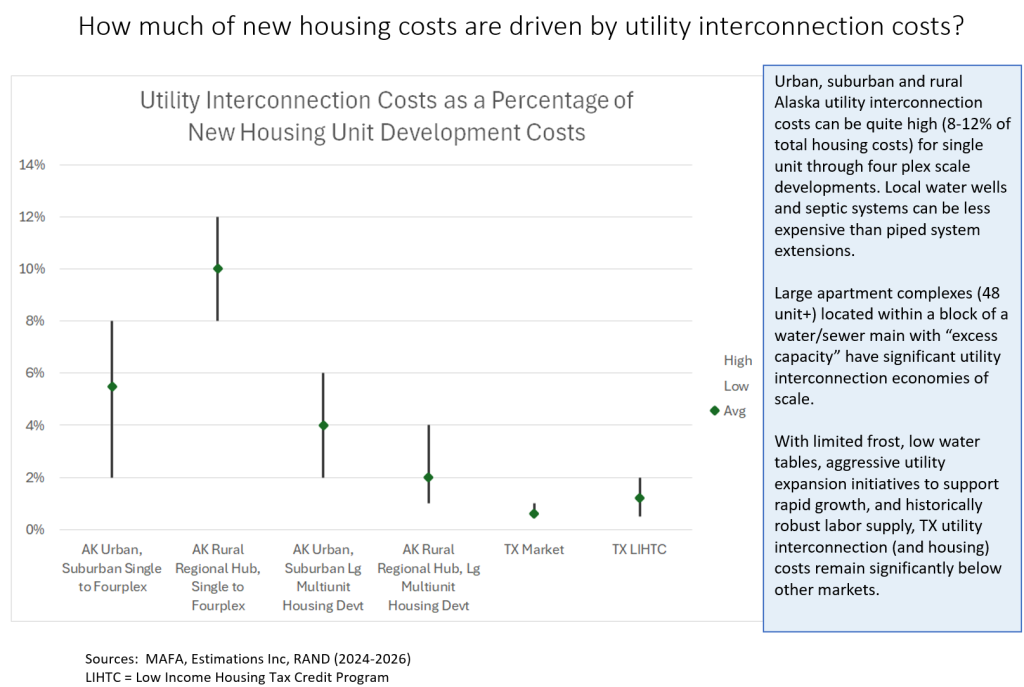
His construction cost data ran from roughly $300 to $450 per square foot in urban Alaska to as much as $2,500 per square foot for large multi-unit developments in rural Alaska. Within those totals, utility interconnection runs 8 to 12% of total housing cost for single-unit through fourplex development here. In Texas, the same figure is half a percent to one percent. The difference is not pipe. It is trench. Anchorage water lines sit at roughly ten feet to stay below frost, which means excavating twelve, and Foster noted that Alberta’s arctic conditions produce similarly elevated costs. Comparing Alaska to warm-ground states without that caveat misleads.
The lever he proposed already exists in Alaska law for big industrial customers. Foster wants it extended to houses.
Here’s the logic. A utility is mostly fixed costs. The pipes, the treatment plant, the crews who maintain it all cost roughly the same whether the system serves 500 customers or 600. The more members who sign up make the overall cost a little easier for everyone else to carry. A new home hooked up to the water system is a new member. For the next 30 or 40 years, that household’s monthly bill helps pay down the overhead costs the utility was carrying anyway.
Right now, though, most Alaska utilities charge a new customer full price for the hookup, as if all those decades of future bills were worth nothing. Foster’s proposal: give the new customer credit for a slice of those future payments, up front, as a discount on the connection.
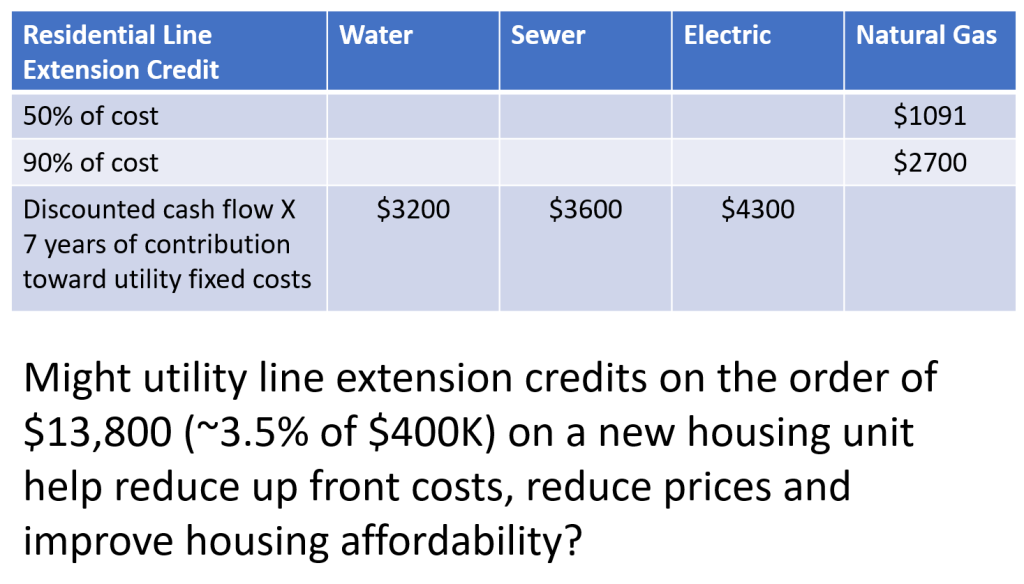
Some utilities already do. Enstar now covers 50% of a typical service line. The Interior Gas Utility covers 90%. One Lower 48 utility does the math explicitly: it adds up about seven years of what a new household will pay toward the system’s fixed costs and knocks that amount off the hookup charge. Run that same seven-year math on Anchorage’s water, sewer, and electric rates, and Foster’s illustrative credits come out to roughly $3,200, $3,600, and $4,300 in savings.
Stack them all and a new home saves close to $13,800.
On a $400,000-plus house, Foster likened that savings to shaving three full percentage points off the mortgage interest rate. “Would you pick up some new houses?” he asked. “I would submit you pick some up.”
Foster labeled this work a preliminary review, and several summary figures remain illustrative pending final analysis.
The Front Step
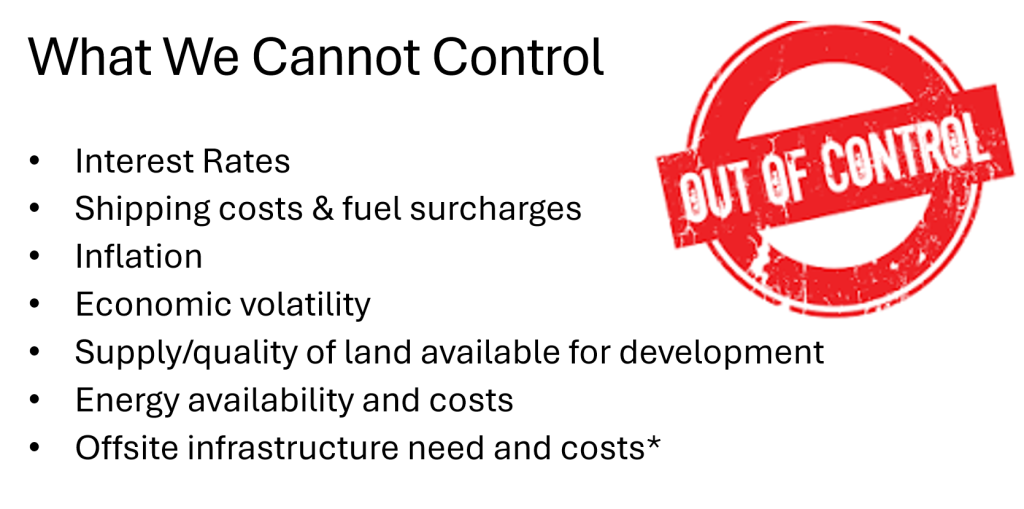
Bob Doehl, Director of the Office of Community and Economic Development for the Municipality of Anchorage, began with what a city cannot touch: interest rates, freight surcharges, inflation, energy costs, and the young-state problem Senator Murkowski raised in Fairbanks days earlier. Alaska lacks the accumulated roads, water, and sewer that two-hundred-year-old states inherited, and building them can cost thousands of dollars per linear foot with no clear funding mechanism, since rate-regulated utilities cannot bank capital reserves for expansion.
Then he told a story about a front step.
A contractor needed to replace a deteriorating deck and back stairway on a house that needed them as a fire exit. Straightforward work. Except that 40 years ago, someone built the front step ten inches further into the setback than the planning director had authority to waive. Fixing a back stairway therefore required a formal variance: an application, a staff report, a public hearing before a citizen commission. Thousands of dollars. Three months. In a town where three months can mean missing the building season.
The step was ten inches out of place for four decades before it cost anyone anything. That is what a thousand-page land use code does when nobody prunes it.
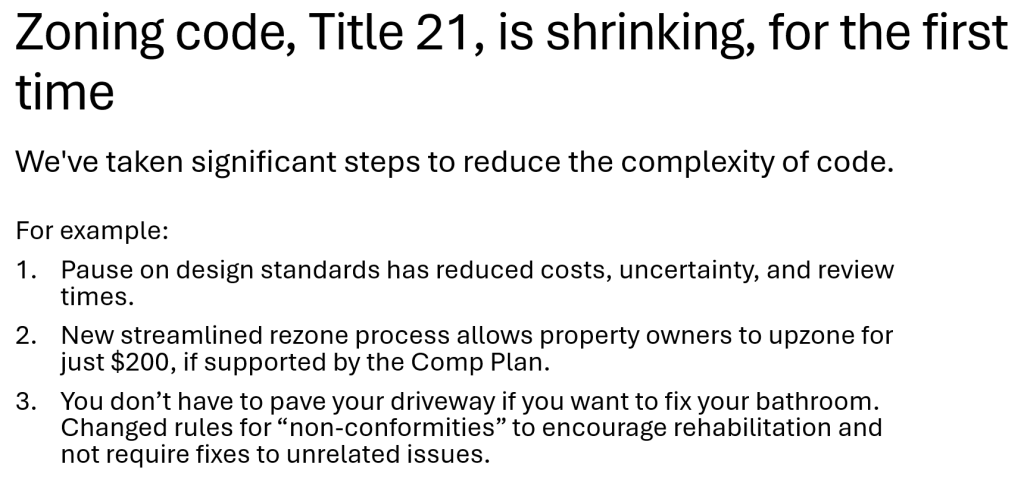
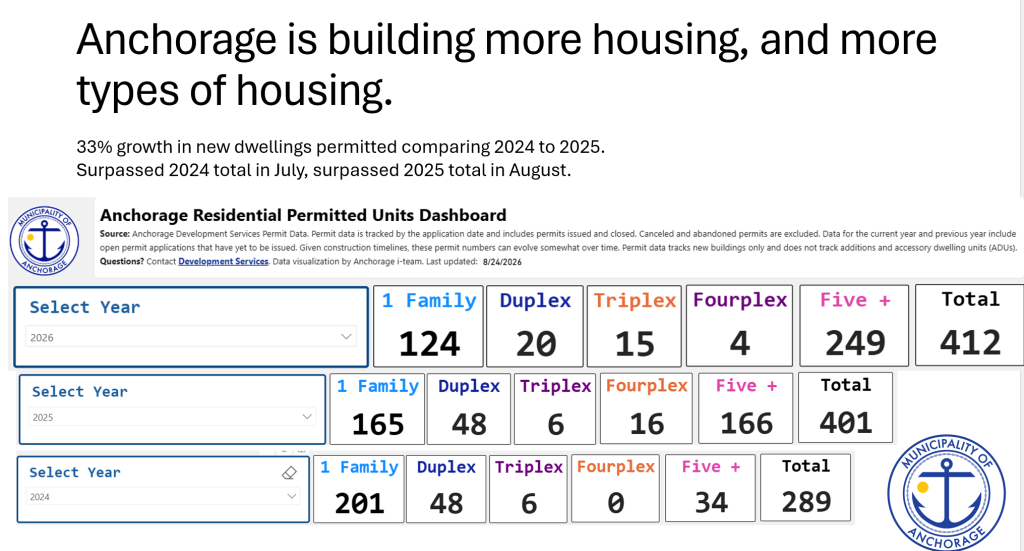
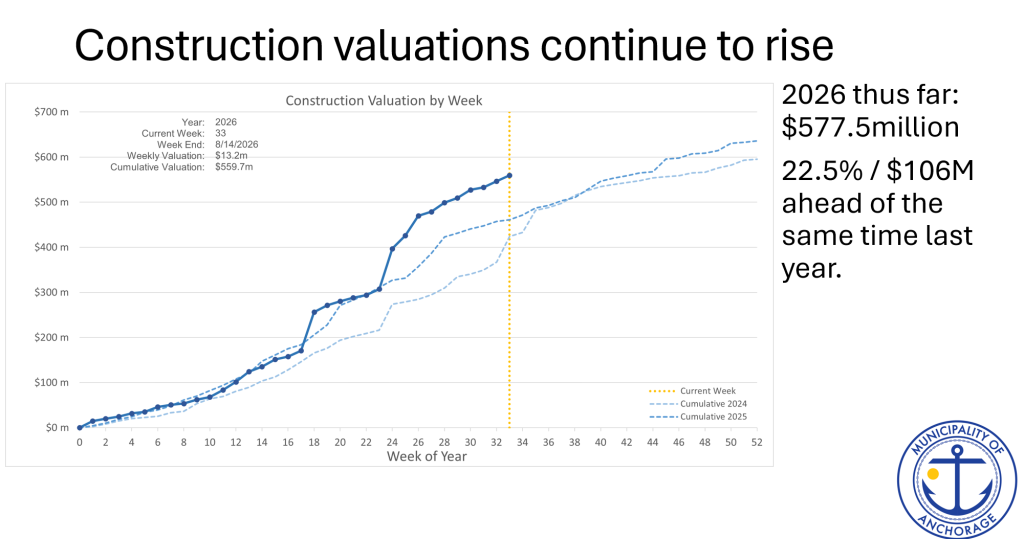
Doehl’s central claim is that the pruning has finally started, and his ledger is real: Title 21 is shrinking for the first time, permitted dwellings grew 33% from 2024 to 2025 with 2026 already past last year’s total in August, and a multifamily tax incentive established in 2025 is directly responsible for 386 new units in two years. A proposal now before the Planning and Zoning Commission would let the director resolve trivial variances like that front step administratively. A rebuilt Title 23 allows single-stair buildings up to six stories, unlocking small downtown lots for residential conversion after what Doehl called a heavy six-month lift with the state.
If the six presentations converged anywhere, it was on this tool. Doehl, Robinson, and Debenham, the regulator, the nonprofit, and the private builder, each independently credited tax abatement, particularly the multifamily incentive, with letting projects pencil that otherwise would not have been built. Robinson described the feasibility gap plainly: for years these developments faced a very real challenge, and but for this tool, they weren’t going anywhere. High construction costs were the one factor no one on the panel disputed. Tax abatement was the one response all three said is working.
The piece he called most exciting says the most about where the municipality has been. A new permit management system arrives in the first quarter of next year. The current one, he told the room, is the equivalent of carbon paper and multiple copies that don’t talk to each other, over-customized continuously since 2005. “We’re finally jumping forward to move into this millennium.”
The View From the Other Side of the Counter
Debenham closed the presentations with the builder’s audit of Doehl’s ledger. His assessment was genuinely warm. After what he described as 20-plus years of nothing working, things are working. Block 96. The Residences at Northwood. Raspberry Townhomes.
Tax abatement, in his phrasing, “erases the sins of bad policy.” And the municipality now answers the phone, which was not always so: “Who am I gonna call? You know, it’s like, I got nobody right now. I can actually call somebody.”
Then he put up a site plan and asked the room to look past the pretty rendering.
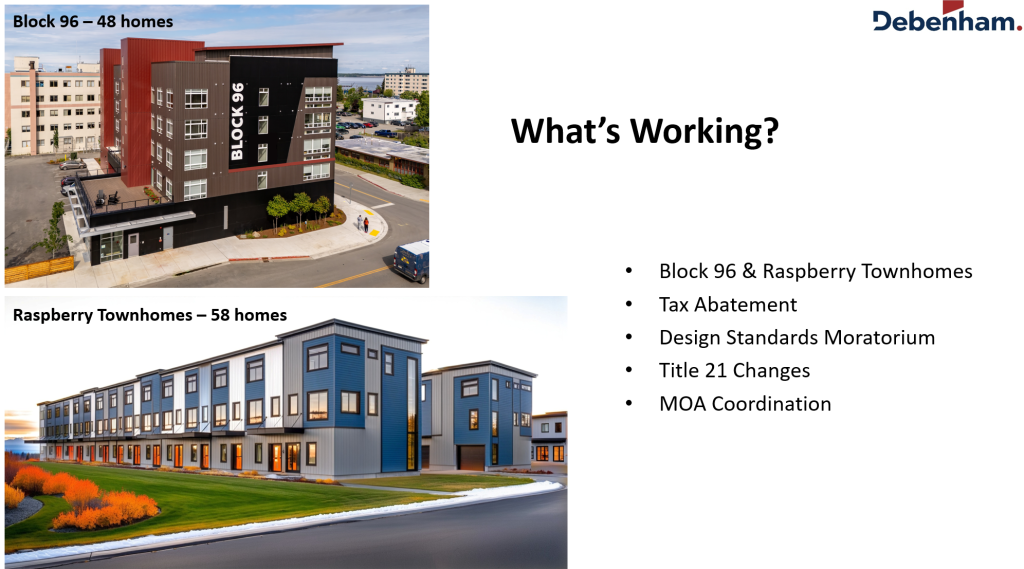
Raspberry Townhomes is a $20 million, 58-townhome project on two and a quarter acres in South Anchorage. Debenham packed in every unit the code allowed and reached 30% lot coverage in a zone that permits 40%, the gap consumed by setbacks and fire code. A standard driveway is 25 feet wide. His fire lanes are 38 and 44 feet, and the fire lane requirement alone consumes 7,520 square feet of asphalt.
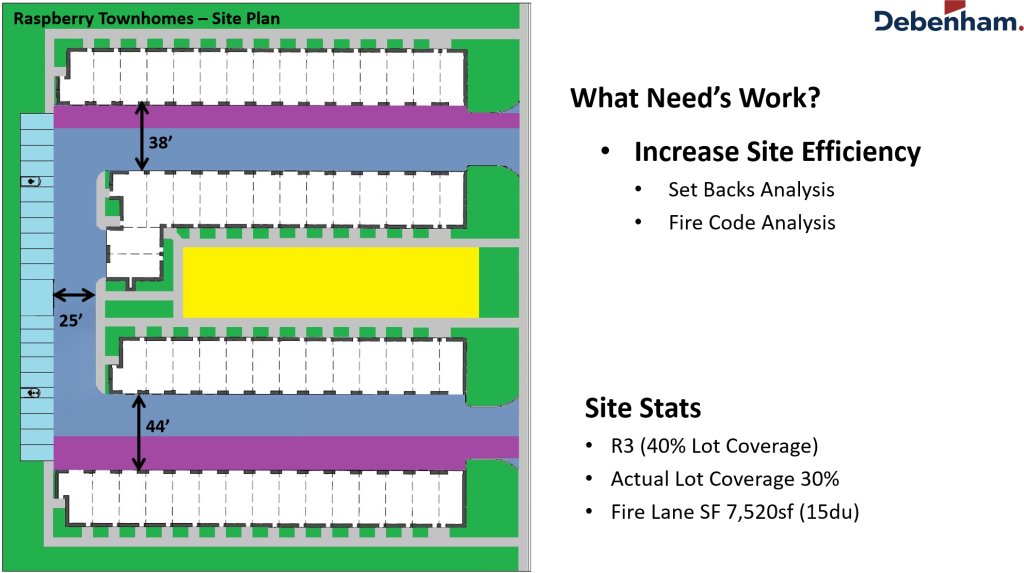
That asphalt is 15 homes.
His question: why is a fire truck dictating housing policy in Anchorage?
His contention: the city doesn’t just need more land, it needs to use the land it has roughly a third more efficiently, and that is a policy choice available right now.
His asks were specific. A comprehensive setback analysis of Title 21 (“somebody’s gotta sit down and do it, and it’s not gonna be me”). A fire code review benchmarked against municipalities that don’t pay this tax. And a change to Chugach Electric’s tariff, which requires one meter per residential door and thereby blocks connecting combined heat and power, microturbines, or solar at the building scale. Debenham was careful with the last one: the utility is complying with its tariff, not choosing the outcome.
On permitting, the panel’s one open disagreement surfaced, politely. Debenham’s last project took nine months to permit, long enough to threaten a foundation season, and his answer is to outsource review and inspection to qualified local professionals. Doehl’s answer is the new municipal system arriving next year. Both agree the current state is unacceptable; they differ on whether the fix is modernization or competition. Readers can start judging the new system by mid-2027.
Housing needs three conditions, Debenham argued: people must feel safe, property rights must be respected, and the surrounding infrastructure must be worth investing next to. Without those, the price of construction is beside the point.
The Waitlist
The afternoon produced an unusually consistent map. The inherited costs are real: frost that pushes trenches twelve feet down, freight that turns a 2×4 into a $13 purchase, rates set in Washington, and a federal partner that has not reauthorized its flagship Native housing law since 2008. But presenter after presenter, from the state agency to the private builder, pointed at levers that are entirely local. Setbacks are a choice. Fire lane widths are a choice. Design standards, permit timelines, and line extension pricing are choices. The question policymakers face is less whether tools exist than how fast Alaska is willing to pull the ones it already holds, and what each year of delay costs in units never built.
Debenham, meanwhile, turns away four to five people a day at his leasing office, seasonal workers among the roughly 7,000 who arrive each summer needing a March-to-September home he isn’t allowed to build efficiently enough to offer.
And Forster told the room how some people who live under NAHASDA’s constraints have re-translated the acronym: Never Any Housing Available, So Don’t Ask. He first heard the joke from a friend on the North Slope.
That friend grew up on a housing waitlist.
This summary is a recap of the information presented. It is not an official record, transcript, or position statement. The content reflects only the views and statements made by the individual presenters and participants at the time of the forum. It should not be interpreted as representing the official views, opinions, policies, or positions of Commonwealth North, its leadership, board members, staff, or affiliates.
Reference Materials
- Daniel Delfino, AHFC: presentation slides [link]
- Griffin Forster, AAHA, “Understanding the ‘Lost Generation’ of Housing in Alaska’s Tribal Communities”: slides [link]
- Bob Doehl, Municipality of Anchorage: slides [link]
- Mark Foster, MAFA, “Where Have All the Houses Gone?”: slides [link]
- Tyler Robinson, Cook Inlet Housing Authority: slides [link]
- Shaun Debenham, Debenham LLC: slides [link]