What's New
The Final Four Candidate Forum: Alaska’s Next Governor, On the Record
Commonwealth North Gubernatorial Candidate Forum
September 17, 2026 | Hosted by GCI, Anchorage
Moderated by Moira Smith, Commonwealth North Board of Directors
Participating candidates: Treg Taylor, Dave Bronson, and Jonathan Kreiss-Tomkins
Editor’s note: This transcript has been lightly edited for clarity and length. Filler words, false starts, and audio-check chatter have been removed, and punctuation and names have been corrected. A short portion of the opening remarks was not captured in the recording. Commonwealth North does not endorse candidates.
Jump to a section
- Opening remarks
- Candidate presentations: Treg Taylor | Dave Bronson | Jonathan Kreiss-Tomkins
- Moderated Q&A
- What makes you feel the most Alaskan?
- One hard truth Alaskans need to hear
- Your first budget
- Growing Alaska’s economy
- Working with a legislature that disagrees with you
- Education funding and the BSA
- Improving educational outcomes
- Crime and recidivism
- The decision that matters most to the next generation
- If oil drops to $50 a barrel
- The Alaska Disconnect: feature or flaw?
- State agency vacancies
- The first ask in Washington, D.C.
- Closing
Opening remarks
Moira Smith: Good evening, everyone. Let’s get started. Welcome to the Final Four.
I’m Moira Smith, a member of the Commonwealth North Board of Directors, and I will be your host tonight. We are grateful to have you join us this evening, both here in the room and online, for this important conversation about Alaska’s future.
For anyone who is new to Commonwealth North, the organization has been the leader in Alaska’s civic conversation for 45 years. It was founded in 1979 by two former governors, Wally Hickel and Bill Egan, one Republican and one Democrat, around a simple idea that still feels relevant today: we get better answers to Alaska’s hard questions when we set aside the politics, when we set aside the personalities, when we focus on the problems, and when we always put Alaska first.
That has always been Commonwealth North’s goal: to bring people together across sectors, across communities, and across points of view for serious conversations about the issues that shape our state.
In that spirit, I want to say at the outset that Commonwealth North does not endorse. We will not be endorsing any candidates, now or at any time between now and November. This forum is for you, not us. Our role is to create a setting for a fair, substantive conversation, and then give Alaskans time to consider, listen, and decide.
It’s worth taking a second to consider how we got here, because this has not been a normal election. There were 17 candidates on the primary ballot, including a dozen Republicans. The top four was not final until September 4, a full 17 days after the primary election, after a withdrawal, a disqualification, and a reversal. And of course, legal disputes continue. So if you lost track somewhere along the way, you’re in good company.
But tonight is simpler: three people, three questions, 12 minutes each, and then a conversation.
Here are the three questions:
- On fiscal policy: With no long-term fiscal plan and a budget more volatile than any state in the nation, how do we pay for the Alaska we want?
- On energy: From Cook Inlet gas to the Railbelt’s future, what is your plan to keep the lights on and costs down for Alaskans?
- On out-migration: Working families are leaving Alaska. What will you do to make this a state where they want to stay, work, and raise their kids?
The order will be the reverse of the primary finish, so the top vote-getter speaks last. We will begin with Treg Taylor, then Dave Bronson, and then Jonathan Kreiss-Tomkins.
This is an interview, not a debate. No one responds to anyone else tonight. Each candidate speaks for themselves, on the same questions, to the same room. After the candidate presentations, all candidates will sit in the chairs for a moderated Q&A. Those questions were also sent in advance. At 5:30, the candidates will move to stations around the room, and the last half hour belongs to you, so you can have conversations with them directly.
I am going to call up Treg Taylor. He is the former Attorney General of the State of Alaska, and his running mate is Candice English. Thank you, Mr. Taylor.
Candidate presentations
Treg Taylor
Treg Taylor: Twelve minutes is a long time. There’s a really good chance that at the end of 12 minutes, I might not be on the ballot again.
I want to talk about some sad realities. Right now, we have some broken systems in state government that are not serving the people of Alaska as designed.
Here’s one example. Parents with a baby in the NICU are stressed out, wondering how they’re going to afford this, praying for their baby, wondering if their baby is going to be okay. They file for Medicaid, which they qualify for, and more than five months go by. No phone call, nothing back, no coverage.
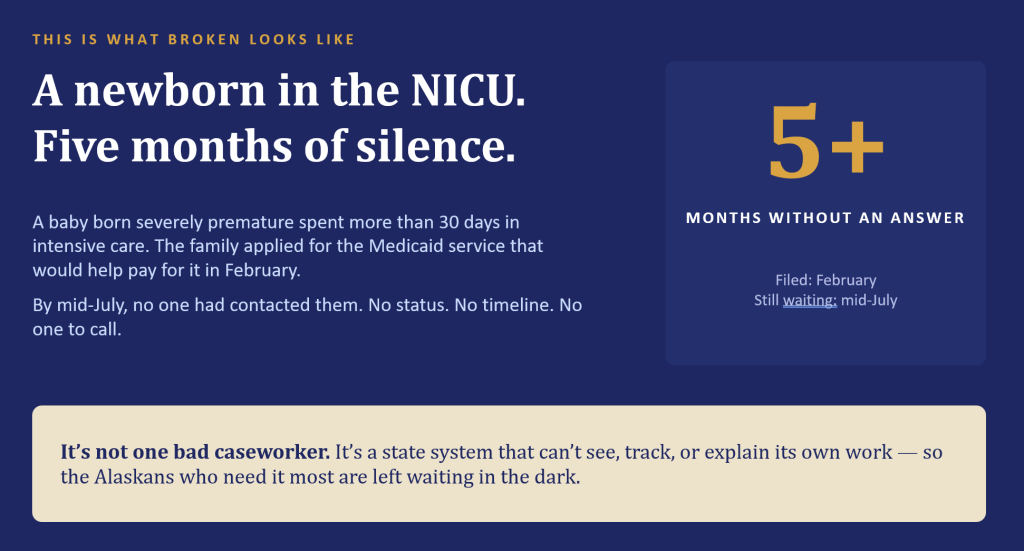
That is just one case out of many. In the past three years, we’ve had over 23,000 kids fall off Medicaid. That doesn’t reflect people coming out of poverty. We’ve had some job growth, and the unemployment rate is down about two percent over that same period, but the child population has dropped by less than one percent. That tells me these children dropped off not because of eligibility requirements, but because of paperwork issues.
That’s unacceptable. One of the state’s biggest jobs is to look after those who can’t look after themselves. This is an epidemic across many areas of state government, and unfortunately many of them affect our children. Look at OCS. Look at the performance of our schools.
It also shows a big need for modernization, bringing in technology to help monitor these processes. McDonald’s provides great service because they care about service. They have the tickers on the wall and they get you through quickly.
What you may not know is that during the four and a half years I was Attorney General, I was fighting a silent battle against business leaving the state, and it was all done in the name of ESG, Environmental, Social, and Governance. There was a big push during those years. We pushed back. We filed lawsuits, we filed opinions on rule changes the federal government was proposing, and we came up with Alaska’s ESG.
We showed that where Alaska has economic development, we have success. People come out of poverty. Look at the Red Dog Mine region: the poverty rate went from 75 percent to 21 percent. Think about the hope all of those families received because there was opportunity. On the North Slope, the poverty rate went from 50 percent to 12 percent. And life expectancy has grown by 12 years since the developments of the 1980s on the North Slope. This is Alaska’s ESG. This is why Alaska has a duty to develop its resources on behalf of its people.
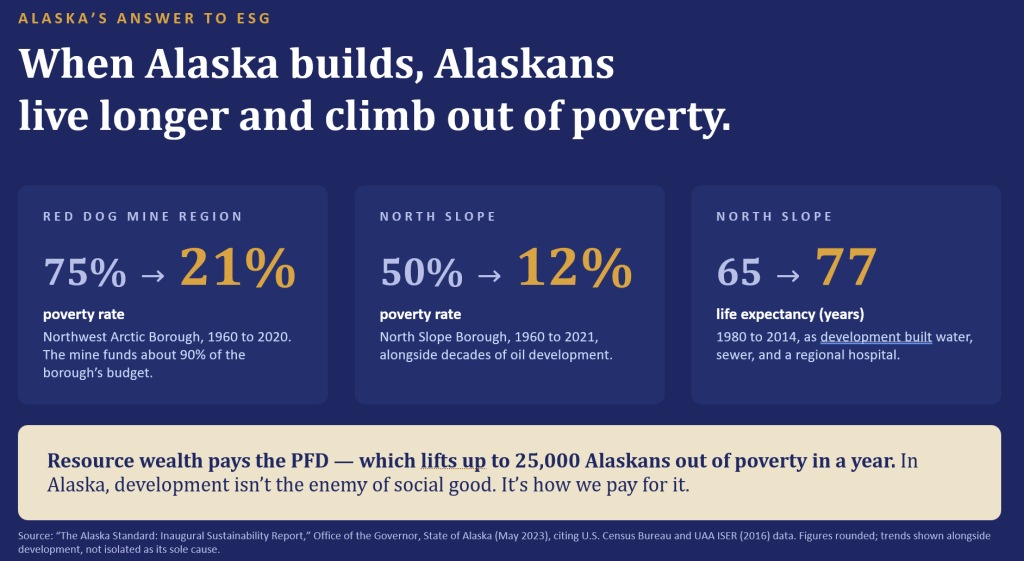
As the chief prosecutor for the state, I saw crime rates and suicide rates drop precipitously in these areas, and it’s because of that opportunity. When people feel desperate and hopeless, you get alcohol, drugs, and all the crime that comes with that. This is our card. We need to be playing it. We have underperformed as a state when it comes to developing the resources God blessed us with.
In the ESG fight, I had a major corporation show me a shareholder complaint. It said, in the name of ESG and climate change, if you do not do these four things, we will forgive you if you pull your business completely out of Alaska. We saw that over and over in the insurance industry, in the banking industry, and with investment advisors who were downgrading investments in Alaskan companies or companies that simply did business in Alaska. There was a lot of pressure on companies throughout the United States to divest from Alaska.
We saw the same thing under the Biden administration, with its 30 by 30 goal: 30 percent of lands and 30 percent of waters in conservation status by 2030. That was never going to happen in Maine, New Jersey, Texas, or California. That entire thing was going to be hung on the backs of Alaskans, tying up our lands and preventing us from developing them. We just saw what resource development does for Alaskans. It gives them hope.
That’s why one of the major policies I want to push forward is: it’s our land. Let’s build our future on it. Right now, 62 percent of Alaska is owned by the federal government, and less than one percent is owned by individuals in Alaska. I am a big proponent of the idea that if you don’t have private land, you don’t have a private economy. We need to put more land in the hands of Alaskans.
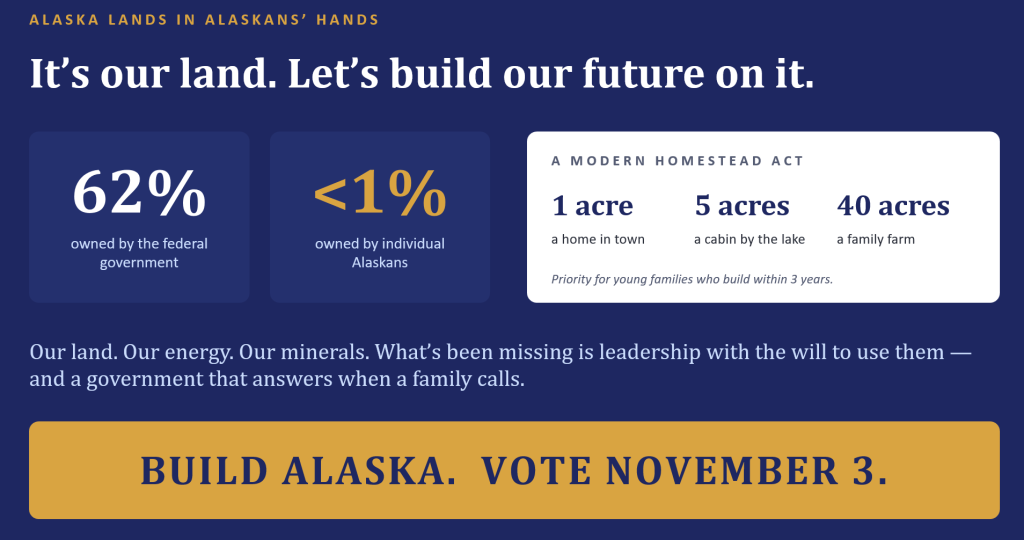
I’m bullish on Alaska’s future. We have so many opportunities, and we are blessed with vast resources that we have a duty and an obligation to develop on behalf of Alaskans.
We spend all this time fighting in Juneau about the budget and the PFD, and yet our roads are still in horrible condition, especially the Haul Road. Travel any major highway in the state and you’ll ask what is going on. Homelessness is rampant. And we haven’t had a major infrastructure project in decades, even when times were good and the price of a barrel of oil was high. No infrastructure projects, no capital budget.
Our first priority as a state is to balance the budget, which means we have to make do with the revenues that come in. As your governor, I’m going to prioritize protecting the most vulnerable, public safety, infrastructure that will move the state forward, and unlocking and unleashing our resource potential: timber, minerals, rare earths. And education. But with education, we spend so much time talking about the amount we spend and very little talking about the outcomes for our kids.
The answer to all three questions we were asked is building our economy to provide prosperity for Alaska families. I’m proud of my record on that as Attorney General. I helped draft this president’s first-day executive order on unleashing Alaska’s extraordinary resource potential. We’re the only state that got an executive order. In it, we selected very carefully those projects we’ve been hoping and praying for in Alaska for the last 40 years, the projects best positioned to move Alaska forward and to help us access our vast resources on behalf of Alaskans. The crown jewel of that, obviously, was the gas line project. I worked very closely on that project and helped implement other aspects of that executive order.
We saw progress on many of those items. We got the rights-of-way for the Ambler Road to the Ambler Mining District. We had a record lease sale in the NPR-A, which, unfortunately, as Attorney General, I had to sue over twice. First, they weren’t going to hold the sale. Then the Biden administration held the sale but put so many conditions on it that they knew no one could possibly bid. We saw a record NPR-A sale, and with it we saw Exxon reinvest in the state and Shell come back. I was in the oil and gas industry when Shell announced in a morning meeting that they were leaving the state, and it was a gut punch. You could feel it for the Alaskans who were no longer going to be employed, for the Alaskans who so badly need economic development.
The second part is that we have to finally get serious about regulatory and permitting reform in this state. We keep talking about it, and yet we continue to be the least business-friendly state in the nation. This last year we were ranked number one, and in seven of the last 15 years we’ve been the worst state in the nation. That’s frustrating, because we know how to fix it. Government needs to get out of the way of business. Government needs to move at the speed of business.
When I talk to business owners, and Jodi and I are business owners, and Candice has a very successful business, Northern Solutions, you feel like the government has its foot on your neck. They’re not there to help you. They’re a roadblock. That has to change if we’re going to have new investment in the state, grow the businesses we have, and bring new businesses in.
We have 50 states, and we can see what’s working. Shapiro has figured this out and is moving Pennsylvania forward. Little in Idaho is moving his state forward. Youngkin in Virginia. They’ve all engaged in this, done it the right way, and already seen the benefits. We’ve got to implement it. In fact, we’ve talked to Little’s and Youngkin’s teams, and they’re interested in helping us with that project up here.
Here’s one example. Has anybody had trouble getting insurance? There are very few carriers in many industries, and yet it takes over a year for the state to process a new insurance product. You’d think we’d be bending over backwards to get new insurance products into the state. In other states it takes a couple of days to a week. We’re over a year. So insurance companies say, why would I go through that effort for a population of a little over 700,000 people? It’s not worth our time, and we’re just not going to do business in Alaska.
I want to end on a positive note. I am bullish on Alaska. We have so much potential: our strategic position within the world, our position as an Arctic nation, the Arctic shipping routes opening up, and our vast resources. I think the future for Alaska is bright, and I think the future for Alaska families is bright. Thank you.
Moira Smith: Thank you, Treg. Next, we’ll call up Dave Bronson, Mayor of Anchorage from 2021 to 2024 and a retired Air Force pilot. His running mate is Josh Church.
Dave Bronson
Dave Bronson: Thank you to Commonwealth North, GCI, and Ron Duncan for doing this. This is a great venue. Twelve minutes. I have to agree with Treg. We’ve never had 12 minutes to talk about anything, so this is kind of cool. Thanks to the board for hosting this.
If you don’t know me, I’ll give a short bio, because there are a lot of new people here who aren’t on the regular stump. My name is Dave Bronson. First and foremost, my wife of 41 years, Deb Bronson, is here. She’s the poor gal who has had to put up with me all these years, and getting dragged into politics in the last few years has been a real challenge for her, with a lot less time on the beaches of Hawaii.
I grew up in northern Wisconsin, went to the University of Wisconsin-Madison, got an economics degree, and went off to the Air Force. I did that for nine years, flying mostly B-1s and B-52s. I came up to Alaska with Northwest Airlines and flew 747 cargo airplanes for about 18 years, then transitioned to Delta Airlines through a bankruptcy and a merger. By the way, I lost my defined benefit plan in that process. That’s a story in and of itself.
When COVID hit, I was bought out of my contract with Delta and decided to run for mayor. I won, and that was an interesting three years. We led the city out of COVID. There were a lot of restrictions. We all remember the dots on the floor at retail stores and the six-foot spacing, which turned out to be meaningless. A lot of people were forcing masks; I didn’t. Mandatory vaccines were coming into the municipality, and I didn’t do that either. We got people back to work at the city, and that was a tough challenge. After that, Governor Dunleavy selected me as director of Ted Stevens Anchorage International Airport, which was a very interesting and, to be honest, great job. Then last September I decided to run for this position. Doing the math, in the last six years I’ve campaigned for three of them, so I’m getting used to this.
I’m going to stay very high level, because a governor has to stay high level. If the governor gets down into the weeds, he’s going to lose. Every executive knows that. My leadership style is to hire really good people, give them the authority, and give them the resources to do their job.
On a long-term fiscal plan: we have to live within our means, and we just don’t do that.
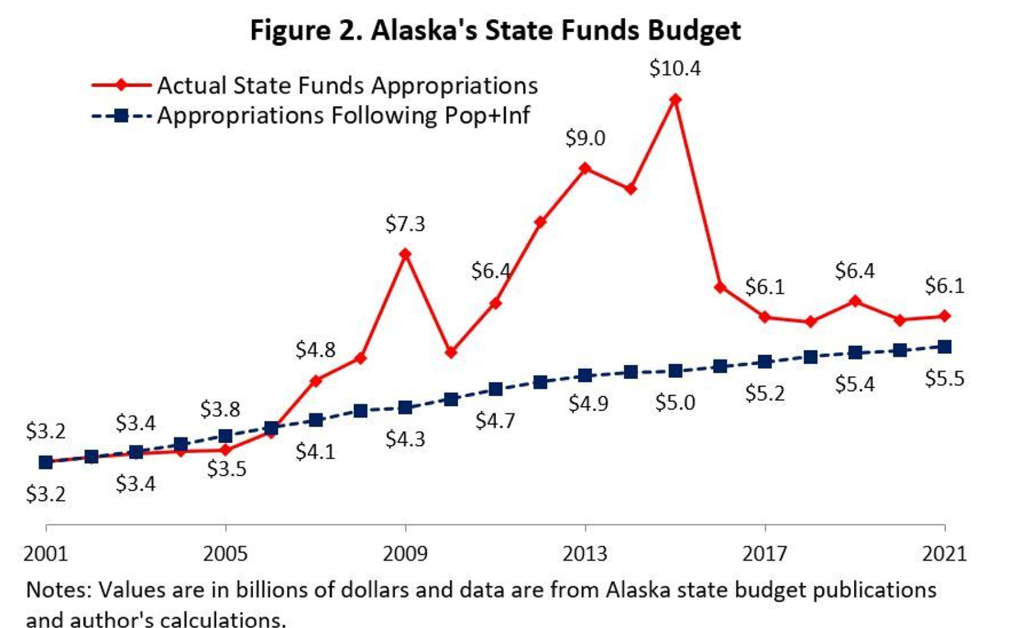
This slide is probably the most important one I have. Look at the date, 2007 to 2008. What happened there? The red line is actual state appropriations. The blue line is the line we were on. Go back to 2001, and our funding was matching our inflation-adjusted budget. Then something called ACES, Alaska’s Clear and Equitable Share, happened. Our government made some big mistakes, and the vertical difference between the red and blue lines is overspending. That’s growing government. We’re still suffering from it. It has come back closer, but this is our deficit spending. A rough estimate of the total gap between the red line and the blue line is $25 billion.
That’s $25 billion we overspent, $25 billion that could be in our reserve accounts, $25 billion that could be funding a full PFD, because remember, the line before that was funding a full PFD. We grew government way too much. We simply did, and there are a lot of Republicans and Democrats implicated in that. There’s blame to go around. I’m not looking back; I’m looking forward. But this explains how we got into the mess we’re talking about, because as Treg said, a lot of our fights are about money.
People talk about a full PFD. I said it in a forum earlier today: the math doesn’t work anymore, because we made a $25 billion mistake over quite a few years. A full statutory PFD is about $3,800 to $4,000, and about 600,000 people are entitled to it. Is it their money? Yes, it is our money. That’s $2.4 billion a year. The notion that you can tax your way or cut your way to a full PFD is nonsensical. If you cut every last state employee, roughly 15,000 of them, all their pay, permanently gone, that’s $1.2 billion. You could get rid of every state employee and be at one half of one year’s full PFD. It doesn’t work.
I’ve been a professional pilot for nearly 45 years, and I never once argued with mathematics. That’s why I get to stand here. I’m not going to start arguing with it now. All the money we were supposed to have in our funds to build and maintain our roads and pay for a full PFD is that cumulative gap between the red and the blue lines. We screwed that up, and it was screwed up even before that. Now we’ve got to fix the problem, and it’s going to take years.
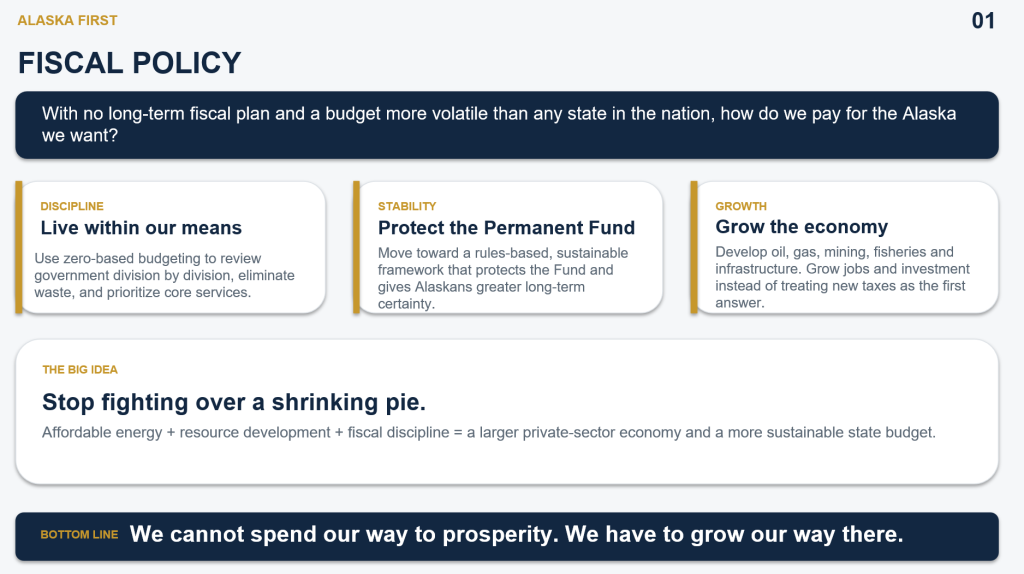
How are we going to do that? You have to protect the Permanent Fund. You simply have to. The $90 billion Permanent Fund is one of two big engines that will grow us out of this. The other is resource development. We need to capture revenue not through taxes but through royalties. Some will propose more taxes and say we’ve got to tax more people so we share the burden. No, we don’t. We need to develop our resources, our gas, our oil, and our minerals, so we can capture royalties. That’s how we grow. You don’t penalize business, and you don’t penalize their employees with a state income tax or a state sales tax to solve a problem that can be solved by growing and developing our resources statewide.
We need to build the Ambler Road. We need to build the gas line. That’s the big one, and I don’t think anyone in this room disagrees. We need to build the West Susitna Access Road, and there are several other roads to mines we’ve got to build.
Growing the corpus of the Permanent Fund is what we have to do. Fifteen years ago, 78 percent of our budget was tied to royalties and income off oil, and 30 percent was from our investments. It’s now reversed: 70 percent of our budget is funded by earnings off that $90 billion, and the other 30 percent is funded by oil revenue and royalties. That is the engine we’ve got to support. I support a single-fund endowment model, because we need to protect that $90 billion within the Constitution so it can pay for government and pay the dividend for generations.
The trouble is that the legislature always focuses on how to tax to get more revenue for state government. I’m not blaming them, but that’s wrong-headed thinking. We need policies that stimulate private business development, because the government doesn’t build roads. The government contracts with private enterprise to build roads. The government doesn’t dig mines. The government doesn’t develop our oil or our gas. The government too often gets in the way of the private industry that does those things. Government has to get out of the way and allow private enterprise to grow. You don’t do that by taking S-Corps and taxing them as C-Corps. You don’t do that with a statewide sales tax when we’re talking over and over about the cost of living in this state. We’ve known how problematic taxes are throughout 6,000 years of recorded history. Do you need some taxes? Certainly. But this notion that we can keep taxing and taxing doesn’t work.
One quick story. In November, I started dealing with a major data center development company. They did two and a half months of due diligence on bringing a data center up here, and after that they told me, “Dave, we’re not going to invest in Alaska, because we think your legislature is going to do to us what they’ve been doing to Hilcorp for the last 12 years.” That’s bad. We need a stable tax structure and a stable business environment that encourages businesses to come, invest in our state, and bring their people up.
On energy: get the gas line built. It simply has to be done. Glenfarne is here today, and I think they’ll speak in favor of that, and I think everyone else with common sense would say the same thing. We need to think in decades. We need to think long-term. That’s why we need to stabilize our tax structure. The legislature needs to treat businesses far more favorably and stop picking on Glenfarne and Hilcorp, because if they can tax S-Corps as C-Corps, every doctor’s office and every small business in this state will eventually be taxed the same way, and that’s not good for any of us.
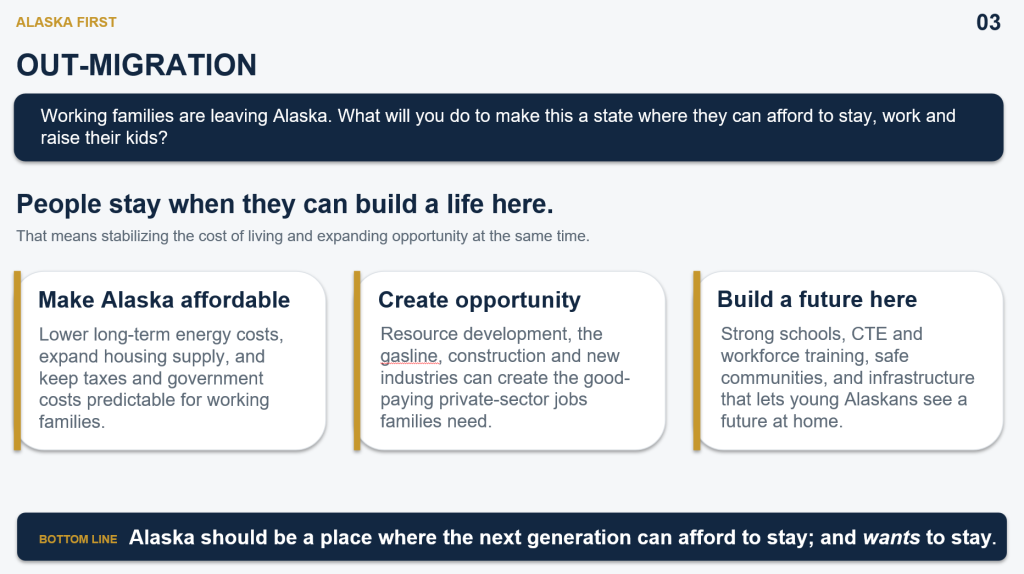
On out-migration: we’ve got to retain people. A quick story. When I was mayor, a major corporation you would all recognize came to me and said they were coming up and bringing about two dozen executive positions with them. A few months later I asked how it was going. Only two of them wanted to come. They went and looked at our public school system in Anchorage and said, “We’re not subjecting our kids to that.” That’s a detriment. Do you think that helps our tax base at all?
So funding for education, forward funding education, is absolutely critical, but we’ve got to demand education outcomes that are positive, good for our kids, and good for all of us. Thank you very much.
Moira Smith: Thank you. Now we turn to Jonathan Kreiss-Tomkins, who represented Sitka in the Alaska House for ten years and whose running mate is Zac Johnson.
Jonathan Kreiss-Tomkins
Jonathan Kreiss-Tomkins: Good afternoon. I’m Jonathan Kreiss-Tomkins, and my more economical initials are JKT. It’s great to be here with everybody. Zac Johnson, my running mate, and I are candidates for governor and lieutenant governor, and we’re really excited to create some positive change in this state. The high-level goal Zac and I have for the future of Alaska is to turn the page on the last eight years and take a high-agency, problem-solving, bipartisan approach to the huge problems in front of us as Alaskans.
Responding to the three questions our Commonwealth North facilitators outlined, I’ll start with the budget. How do we pay for the Alaska we want? How can we have a durably and sustainably balanced budget? This is arguably the single most important question waiting for the next governor and the coming legislature.
I share Mayor Bronson’s belief that the Permanent Fund is a cornerstone of the state, and it is the single most important reform I want to pass as governor, working with the legislature. Dave touched on many of the merits of creating a single-account endowment for the Permanent Fund that is constitutionally protected from overspending. I have some history with this. In 2019, I introduced House Joint Resolution 18, which did exactly this, working in partnership with the Permanent Fund Corporation trustees. That legislation is still active in Juneau, and the co-sponsor list gets longer with every passing legislature.
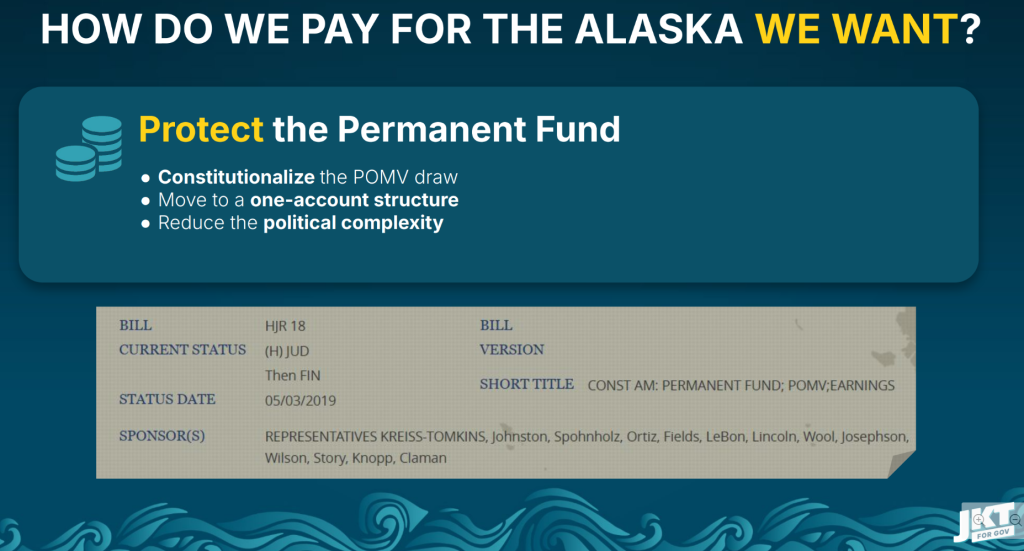
It’s one of the most important reforms we need to pass, for a variety of reasons. First, a healthy portion of the Permanent Fund is vulnerable to simple-majority appropriation at any moment in time. I strongly believe it is a question of when, not if, a future legislature will overdraw the Permanent Fund, because the right combination of political pressure and economic factors will create the short-term temptation to dip in and grab an extra couple hundred million or an extra billion dollars, just that one year, under extenuating circumstances. I can hear the press release already. The moment we do that, we go down the path of fiscal ruin for Alaska. The Permanent Fund is the single most important asset for our state. It needs to be managed prudently and responsibly, and it needs to be afforded a level of constitutional protection it does not currently have.
The legislation I advanced had great bipartisan sponsorship. This should be a bipartisan issue, and it is a bipartisan issue. That is priority number one for our fiscal future.
Another reason a single-account endowment is so important is that it reduces political complexity. With the earnings reserve account vulnerable to simple-majority appropriation, every year is the ultimate political marshmallow test. If you know the marshmallow test from child psychology, you give a kid a marshmallow, and if they can muster the discipline not to eat it for three minutes, they get a second one as a reward for self-discipline. Right now, every year, the legislature has to go through the fiscal equivalent of the marshmallow test, and the political energy and oxygen consumed by not overdrawing the Permanent Fund distracts from the fundamental fiscal issues we should be focused on. We have a governor who has proposed budgets for eight years running that overdraw the Permanent Fund. Taking that off the table lets us focus on the more important, and frankly harder, questions and trade-offs.
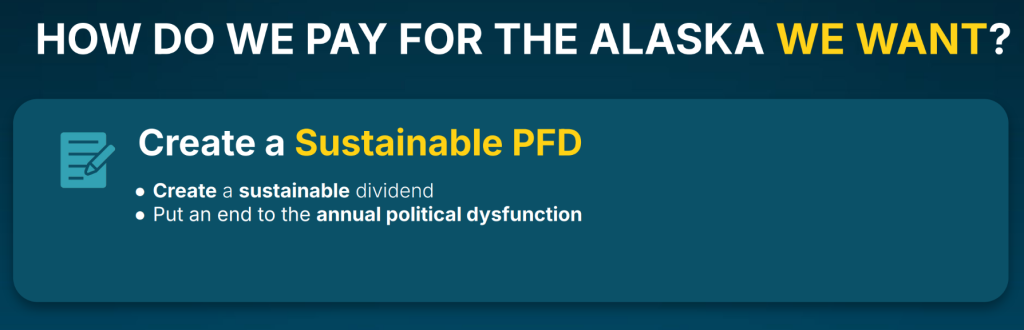
Which is a good segue to the next item: a sustainable Permanent Fund dividend. Again, I find myself in general alignment with Mayor Bronson. As a legislator, I voted for what I considered sustainable PFDs: dividends consistent with a balanced budget, that wouldn’t overdraw the Permanent Fund, and that would afford a reasonable and adequate level of state services. Right now, our statutes are out of alignment with how the legislature has been exercising its constitutional power to appropriate, and we need to bring the two into harmony. That is a difficult political question, but it is a compromise I believe needs to be brokered, and one I would support as governor.
Element number three: reasonable revenues. Right now, I don’t believe there is parity within the oil and gas industry on corporate income tax. One of our major oil and gas producers does not pay corporate income tax, while Exxon, Conoco, and soon Santos will be paying it, which is a fact we should celebrate as Alaskans. New development on the North Slope is great for the State Treasury, great for our economy, and great for jobs. There should be parity within that industry, so closing that loophole is important.
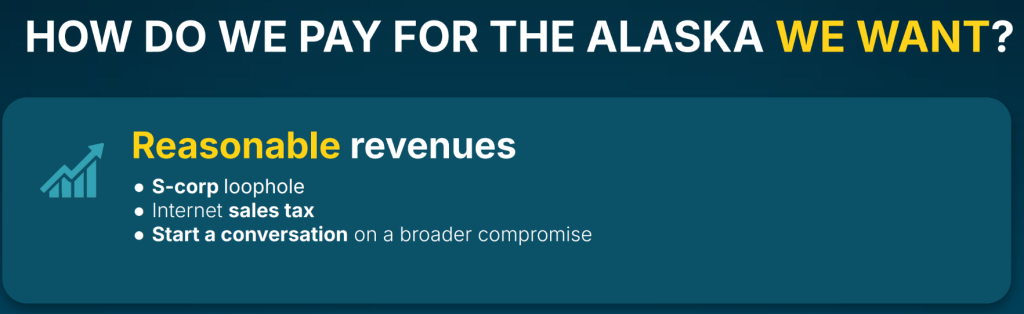
There is also common-sense legislation that has passed Juneau with bipartisan support: collecting sales tax from online commerce businesses. I think it was a 26 to 14 vote in the House and a 15 to 4 vote in the Senate. I might be off by a couple of votes. It was vetoed by this governor. There are common-sense revenue measures with bipartisan support that we should get done, and as governor, I would sign them. We also have to have a conversation with the legislature about more diversity in revenues and what broader-based revenues look like for Alaska. That’s a responsible conversation to have, and it should happen in partnership with the legislature.
Item number four, which might be a bit of a surprise to the room: downward pressure on the operating budget. There are parts of the budget where Alaska has made short-sighted decisions in how we fund core services like education, and education funding needs to increase. But, not mutually exclusively, we should also be looking at how state government is fundamentally structured, where there are inefficiencies, and where there is opportunity to deliver services more efficiently and find operating budget reductions.
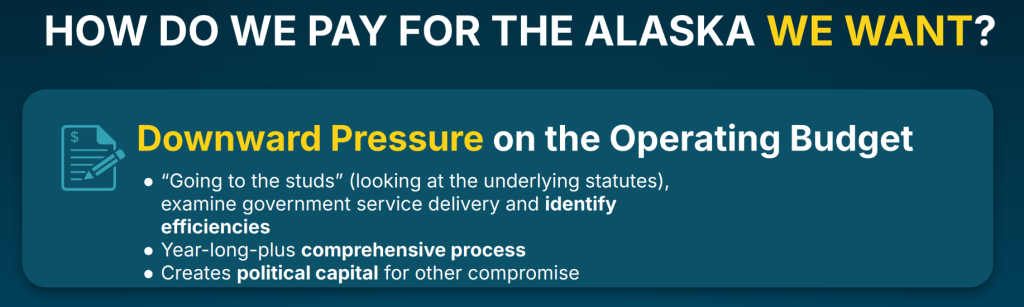
My real frustration as a legislator was that a lot of operating budget conversations at the Finance Committee table, or God forbid on the floor of the House or Senate, were highly reductive, almost politically performative conversations about hacking at the budget with decrements. My strong belief is that the State of Alaska will find operating budget efficiencies by going to the studs: looking at the fundamental statutes of how state government is structured, how agencies deliver services, and the questions that ultimately bind a legislature to certain levels of funding. This is really hard work. It doesn’t surface in a floor speech when you’re trying to pass the operating budget. It’s a year-long or longer process where the legislature and the executive branch work together, perhaps mediated by a third party with expertise in service delivery, a Boston Consulting Group or a McKinsey, to figure out how the State of Alaska can do the same things more efficiently and better.
I want to endeavor in that process in good faith. It’s good on the merits. And especially coming from a Democrat, I think it shows good faith and common cause with conservatives who are concerned about budget growth. That shouldn’t be a partisan issue, and as part of brokering a broader compromise, it’s something the State of Alaska should pursue.
That’s a segue to the second question: energy, and how we keep the lights on and costs down for Alaskans. I’m a big believer that the state should be making generational investments in energy. Right now it is one of the biggest question marks for our economic future. The state has taken big swings in the past. Bradley Lake passed by a hair in the legislature in the late 1980s, but it was one of the wisest decisions the state ever made for its long-term future: four cents per kilowatt-hour, 120 megawatts. Can you imagine where the Railbelt would be right now if the legislature hadn’t made that generational investment? We are due to make similar investments, both in new energy sources and in transmission infrastructure like the intertie project that currently has a $145 million funding gap.
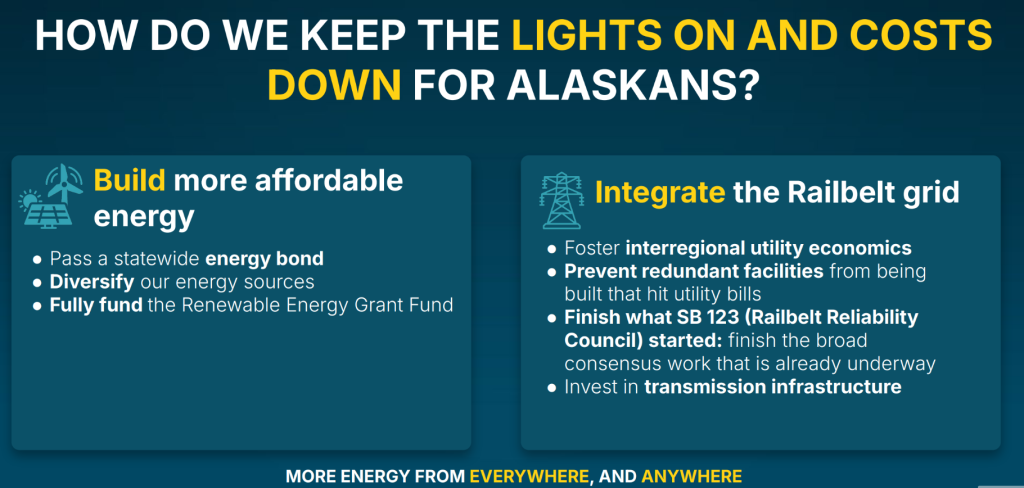
We also need to look at the system of energy delivery in the Railbelt and work toward an integrated Railbelt grid. Economic dispatch is something we should work toward, and the governor and the legislature need to provide leadership to get there.
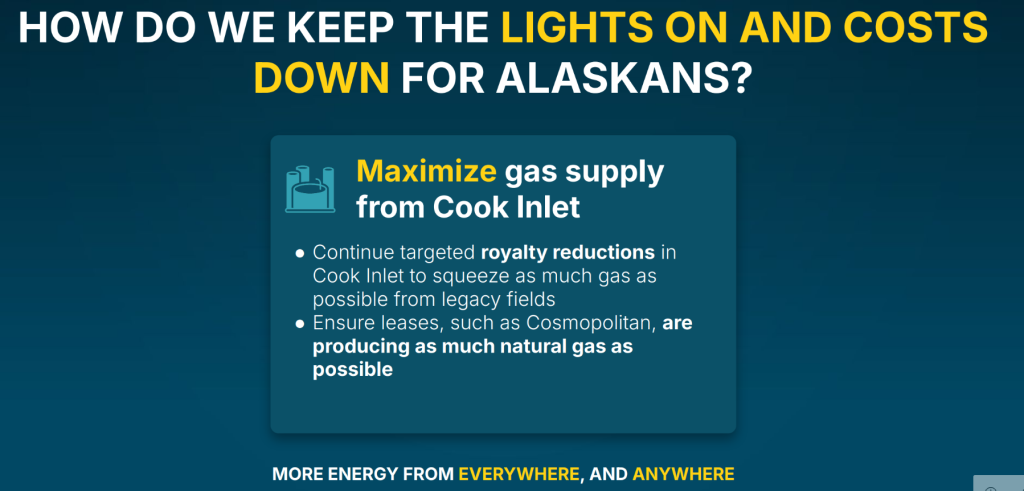
As part of energy, we need to maximize the Cook Inlet basin. I believe DNR has been doing a very good job maximizing the public interest in Cook Inlet. DNR’s plans of development for both Kitchen Lights and Cosmopolitan have forced those producers to step up and produce more gas, which Southcentral desperately needs. That needs to continue. We should be open to targeted royalty reductions that would incentivize more natural gas production in the basin. In the short term, getting everything we possibly can out of Cook Inlet is an urgent priority.
The last question is how we reverse out-migration and make Alaska a place we want to be. I’ve already touched on some of it: energy, and fully funding education. As Mayor Bronson said, it’s a retention problem right now, especially for professionals. We need to drive down the cost of housing, unlock state land for new housing, and create regulatory certainty for prefab and modular housing.
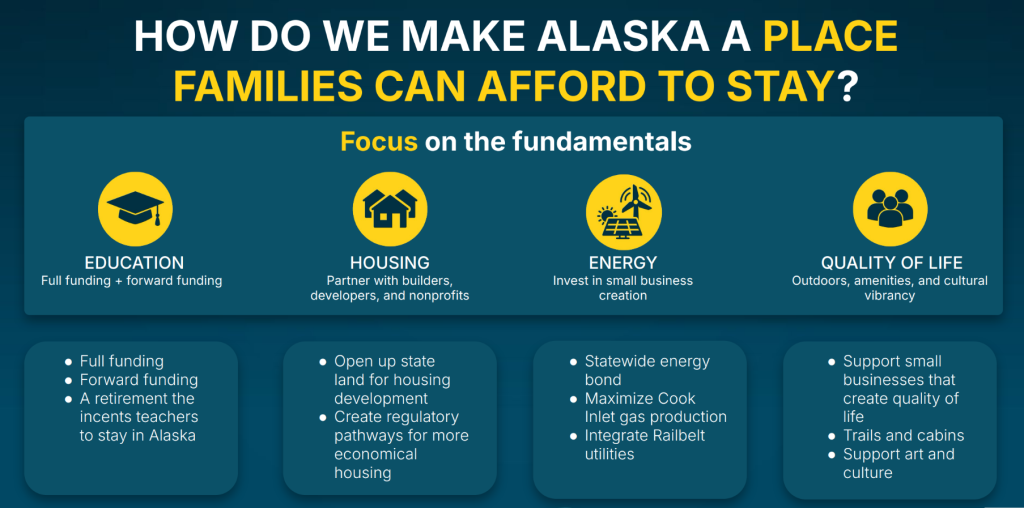
But with my last 30 seconds I want to speak to quality of life. We can have nice things, too. It doesn’t have to be all doom and gloom. The last eight years have felt like a wet blanket era for Alaska. We can rip that off. The state is capable of investing in and supporting small businesses that create quality of life, the Anchorage Wolverines, Showdown Productions, you name it, that make a community a place you want to live. Trails and cabins: I want to see more public-use cabins built, I want to see the Alaska Long Trail built, and I want to see an alpine hut-to-hut system in the Chugach like they have in New Zealand, Alberta, and the Alps. These are things we can have as Alaskans, and investing in those kinds of assets is a really important priority as well. Thank you so much.
Moderated Q&A
Moira Smith: I have to compliment each of you for being so time-adherent. Thank you for not making me get out the hook. Let’s set aside the campaign and set aside work, and start with a warm-up question that should make all of us feel good.
When you’re not working, what do you do that makes you feel the most Alaskan? Treg, we’ll start with you.
Treg Taylor: It has to be being in Alaska with my kids, whether it’s fishing, hunting, or hiking. Doing the Alaska things: showing your kids how to tie a knot, pulling hooks out of your kids’ cheeks, watching the smallest one fall in the river and get wet and cold. These are things every child should experience. For me, that’s where I find the most joy. It’s with my family.
Dave Bronson: My kids are grown and gone, and very successful, by the way, so it’s changed. Now it’s my wife and me snowmachining, or flying my plane out to Lake George for a picnic at the lake, hiking in, camping a little bit. Pretty simple stuff, but that’s what we like to do.
Jonathan Kreiss-Tomkins: Not an original idea, given the last two, but running my skiff up the coast from Sitka. The outdoors are what make Alaska, Alaska. Crabbing, being outdoors.
Moira Smith: Thank you. We’ll start with Dave and transition to the serious stuff. What is one hard truth you think Alaskans need to hear from their next governor?
Dave Bronson: I addressed it earlier. As painful as it is to say, the money for a full PFD, year over year, isn’t there. It just isn’t. We can work toward it, and it will take several years to get us there, but we’ve got to do it.
The other thing that’s more pressing right now is this: we’ve got to build this gas line. We should have started this summer. Because of relationship problems between the legislature and the governor’s office, it didn’t get done. That’s our future. Just like TAPS. Where would we be without TAPS right now? Where are we going to be in five, ten, or fifteen years without that gas line? Cook Inlet has a lot of natural gas, but it doesn’t have enough. We need to get to Phase 2 quickly and monetize it by exporting our LNG. That has to happen yesterday.
Moira Smith: Jonathan, what’s one hard truth Alaskans need to hear from their next governor? And a reminder to all of you that these answers are 60 seconds. Austin has the time card, and I will give you an urgent look when it’s time.
Jonathan Kreiss-Tomkins: There are trade-offs in a balanced budget. The puppies-and-unicorns notion that you can have it all, a $4,000 PFD, no taxes whatsoever, and a level of services that doesn’t make Alaska look apocalyptic, is intellectually dishonest. Having a balanced budget and all of those things in balance is going to require trade-offs, and for some, that is a hard truth.
Treg Taylor: I touched on it in my introductory remarks, but the State of Alaska is failing our children on too many levels. These are the core responsibilities of state government. Whether it’s the precipitous drop of children on Medicaid because we’re not processing applications on time, or our public education system. Do you know the percentage of kids reading at grade level in Western Alaska? Four percent. Do you know what the Anchorage and Fairbanks school districts’ goal for kids reading at grade level is? Not 90. It’s 48. Where is that a passing grade on any level? And the sad thing is, we know what works. Don’t get me started on OCS and child protection. Some of these things can be fixed simply by following the law and the timelines in statute. We’re failing our kids on those three levels.
Moira Smith: We’ll start with Jonathan this time. This is a long one, so I’ll read it once for all three of you. You would take the oath, if elected, on December 7, and by law a budget goes to the legislature by December 15. In practice, you inherit your predecessor’s budget and amend it on the fly. What’s the most significant change you would make to that first budget, and what does it cost or save?
Jonathan Kreiss-Tomkins: It would be balanced, which I am embarrassed to say would be a fundamental departure from the last eight years of budgets our current governor has delivered to the legislature. It would not overdraw the Permanent Fund. It would be a balanced budget.
Treg Taylor: I agree. The first responsibility of a governor is to propose a balanced budget. In future budgets, we also need to implement a zero-based system, so it’s not just an automatic increment for every department, agency, commission, and board. You have to justify your budget every year, and part of that is auditing. There are departments that haven’t been audited for years, and positions that have been empty for years. You’ve got to figure out whether those positions are empty because we’re not competitive and desperately need them filled, or whether they’re just being used by departments to pad their budgets. There are things we need to do on day one, but a balanced budget is the primary responsibility.
Dave Bronson: A balanced budget is actually required, and I would certainly work toward that. But this notion that in eight days you can take a roughly $15 billion budget and make big changes: you’re a victim of the process. You’re stuck with it. You can make one, two, or three big changes, but you still have to balance the budget.
On zero-based budgeting, when I was at the city I essentially did that, and it is time-consuming in the extreme. We had a $600 million budget at the city; the state’s is $15 billion. The executive has to be involved at a very detailed level. I remember as mayor arguing over a $12,000 expense in one department, out of $600 million. That’s important, maybe not mathematically, but in principle, because it communicates to your directors, or at the state your commissioners, that you’re deadly serious. Josh’s and my proposal is that every four years we do zero-based budgeting.
Moira Smith: Treg, what policies will you prioritize that will grow Alaska’s economy?
Treg Taylor: Energy, land, and regulatory and permitting reform.
On energy, the next governor has to pursue all energy sources. We know there’s gas in Cook Inlet, and we’ve got to incentivize that production. I got letters from the legislature telling me to force these companies to produce more oil and gas and take on the capital expenditures, but there was no economic reason for them to do that. They’d be putting themselves out of business.
On land, we need to get lands into Alaskan hands, and we need to hold the federal government to its promises at statehood and get the lands we were promised, whether it’s the submerged lands under navigable waters or the rights-of-way to access our critical minerals, other minerals, and oil and gas.
On permitting and regulatory reform, we have to change the business environment in this state. We need to be inviting to business. It’s hard to do business here. We’re remote, and the cost of goods is naturally higher. We’ve got to do everything we can so that government supports business.
Dave Bronson: There are a lot of opportunities for success here. I’m a big believer in data centers. I know that might be unpopular with some folks here, but I think it works if done right. In Alaska, our challenges always come down to logistics. We’ve got to produce something and ship it, whether it’s mining, logging, whatever. With a data center, you’re creating ones and zeros. It’s data. You put it on a fiber optic cable and send it to Seattle or Portland. The logistics are minimal, and there’s a lot of money in data centers.
You’ve got to deal with the noise, the cooling, and certainly the electricity. The groups I’m talking to have said they won’t take our electricity because it’s not reliable enough. It’s not five-nines electricity. They will produce their own and build their own data centers. That’s good for us. That’s a very strong revenue source.
Jonathan Kreiss-Tomkins: I would focus on the fundamentals. That’s where state government should be focused when it comes to growing the economy: creating a foundation the private sector can build on. And the fundamentals are a little wobbly right now. Energy, as already discussed, is a huge crisis in Alaska and also a huge opportunity for state investment. Brick-and-mortar infrastructure: you need ports and harbors. The Port of Alaska, and the harbors and harbor infrastructure of coastal Alaska, power the fishing industry that powers coastal Alaska. Roads need to be suitable for commerce. And the last is education, which is very fundamental for the state. If you don’t have schools that parents or employers have confidence in, that ultimately hamstrings your ability to grow the economy.
Moira Smith: Dave, we’ll start with you. It’s a long one, so everyone, please listen. For most of the last decade, the Alaska Legislature has been organized by bipartisan coalitions rather than party caucuses, and whoever wins will have to work with legislators from different parties. What have you done in your career so far that shows how you would work with a legislature that disagrees with you?
Dave Bronson: I think I’m the one person here who has already done that. I look forward to going down and dealing with a roughly 50-50 split in the legislature. You’ve got to understand that a Republican governor, and I’m a Republican, is the leader of the Republican Party, and therefore the leader of the Republican caucus in Juneau and throughout the state.
I had a challenge with the Anchorage Assembly, which was about 9 to 3 against me. But guess what? We agreed on 70 or 80 percent of things. We still got the roads built and the projects done. The other 20 percent was largely about homelessness. I had a great solution for that. They didn’t like it. Halfway through a concrete pour, they stopped the project. But we still got things done, and remember, that was during COVID, when the whole environment was supercharged. We still worked together. I’ve done that, and I’m looking forward to working with the legislature.
Jonathan Kreiss-Tomkins: One of the most important things for a governor is establishing a respect-based, trust-based relationship with the legislature. My last six years in the legislature, I was in a bipartisan coalition of Democrats, independents, and Republicans. I believe in that model of governance. Some of the pieces of legislation I worked on most were collaborations with people on the far other end of the ideological spectrum. Mike Shower and I wrote an elections omnibus bill in 2021 and 2022 as the respective House and Senate State Affairs Committee chairs, and that legislation just passed the legislature, only to be vetoed by the governor. Finding common ground with Mike Shower is something I’m motivated by. I want to bring that spirit of governance to the third floor.
Treg Taylor: As Alaska’s Republican Attorney General, I was voted unanimously by the Democratic and Republican attorneys general of the Lower 48 to chair the bipartisan Attorney General Alliance. We worked together, and what we did was basic: we communicated, and we treated each other with dignity and respect. We got a lot done, so much so that PBS did a series on us, asking why, in a time of total dysfunction between the parties, we were able to get so much done.
We held Big Pharma responsible for the opioid epidemic when they were lying about how addictive opioids were, and I received $100 million to fight opioid addiction in Alaska because of that. We went after tech companies that were abusing our privacy rights, and we did that successfully together. We also approached social media companies that were letting children onto their sites at inappropriate ages without adequate parental controls. We had discussions with those companies, and if they didn’t heed us, we would file lawsuits.
Moira Smith: Jonathan, we’re going to turn now to two questions about education. We’ll start with funding and move to policy. The base student allocation is $6,660. Each $100 increase costs about $25 million a year, and inflation-adjusting it over the past decade would have put it near $7,600. Give us the number you’d put in your first budget. If it’s higher than $6,660, tell us where the money comes from. If it isn’t, tell us what you would change so districts can live within it.
Jonathan Kreiss-Tomkins: Ultimately, the state needs to get back to a place where education funding is in approximately inflation-adjusted terms. Look at the state of public education in Alaska right now. If schools aren’t outright closing, you’re seeing electives shut down, sports shut down, teachers leaving the profession, and the highest teacher vacancy rate in recent history, two to three times the national average. Every indicator light is blinking red. Our education system is at a breaking point. So funding is really key.
It’s also “and both.” We should be looking at policies and structures that promote improved outcomes along with increased funding. It doesn’t have to be one or the other. But the beatings-will-continue-until-morale-improves approach of a defunded education system isn’t working. Morale is underwater.
Treg Taylor: I’m not sure what that number is yet, but I am committed to fully funding our children’s education. It’s a big focus for me, maybe because I have six children, three of whom are still in the Anchorage School District. What we know is that our schools are failing our children, and we know that increased funding hasn’t produced increased scores. So it’s not all about funding. Our discussions in Juneau will be about how we get the results our children deserve.
It’s really about more money going to teachers and into our classrooms, not funding administration, properties, or buildings. And the sad thing about this predicament is that we know what works. We’ve seen states completely turn this around in a matter of years. Mississippi went from dead last to almost the top. Florida went from the middle to the top. We implemented part of that with the Reads Act. What we failed to implement was the accountability portion, and without accountability, you don’t get the results you’re looking for.
Dave Bronson: Not unlike Treg, I believe we need to forward fund education in the budgeting process, by March 1. I don’t know what the number is, but it’s probably around $6,660 to $6,700 going forward. It’s not just a matter of how much; it’s a matter of when. By March 1, we need to have that number locked in so we’re not pink-slipping teachers and then trying to hire them back in June. That’s a lot of the reason teachers say they’re done. They can’t plan. It’s not unlike what we’re doing to the oil industry: we keep changing the tax code, and developers don’t want to come up here because they don’t know what we’re going to do to them. Anything big that involves money needs programmability and long-term stability, and we’re not providing that now.
And I hate to talk about the funding of education without talking about performance. We’re dead last in the country. We have the worst-educated kids, but guess what? Some of our kids are the best, and they’re in our charter schools. They’re some of the best-educated kids in the country.
Moira Smith: You’re anticipating my next question. Treg, we’ll start with you. Alaska’s educational performance ranks among the bottom of all states. What specific non-fiscal tools would you use as governor to improve educational outcomes?
Treg Taylor: There are a lot of things we can do that don’t require an increased budget. One is forward funding education so districts can adequately plan for the next school year. The second, which I’ve already mentioned, is fully implementing the Reads Act so there’s accountability, and coupling it with a math act. Those are the two skills we are completely deficient in right now.
The other thing is protecting parental options. I have six kids, and they’re all completely different. They’ve all taken different educational tracks, and because of those options, whether charter school or correspondence school, we’ve been able to put each child where they’re going to be successful, and the parent knows that. We’ve got to protect that. As Attorney General, when the teachers’ union tried to take away our correspondence program, which serves 22,000 kids, I fought back and we won. We kept that option open. What we don’t need is less competition. We need more competition to improve those scores.
And then we need to knock down the credentialing and housing problems we see in rural Alaska, so we can better serve those students with teachers who are ready to go and ready to teach.
Dave Bronson: This is certainly complex. Treg mentioned a lot of the challenges we’re facing. But we need to ask why we have a funding problem in education, and it’s because many parents are taking their kids out of public school. Why? I’ll tell you the reason: too many parents find us indoctrinating their children instead of educating them. What we’ve got to get back to is educating in a classical, liberal arts environment. Teach our kids the classics, teach them to read, and teach them to compute. You’ve got to teach them to read so they can teach themselves. Learn to read so you can teach yourself.
Mississippi did that. It was called the Mississippi Miracle. I know this question is about non-fiscal tools, but it was a funding issue. What they did is put reading coaches throughout the state, serving 460,000 students. They went from dead last in 2012 to the top ten today. We can model that. This isn’t rocket science.
Jonathan Kreiss-Tomkins: I agree with Treg and Dave that forward funding should be a bipartisan structural reform. It doesn’t cost a dollar more, but it adds value through less administrative waste, better retention of teachers, and the ability to proactively and positively plan for a coming academic year. It’s a huge reform the state should pursue after talking about it for decades and never acting on it.
The other area I’d focus on is cultivating a culture of constant improvement within the teaching profession. As a legislator, I was really interested in providing recognition for National Board certified teachers. In the data and evidence on education, the single best predictor of a student’s educational growth is an excellent teacher. We should be focused on having excellent teachers at the head of every classroom and on helping teachers continually improve their craft. Teaching is a craft, and we should support that.
Moira Smith: Dave, we’ll start with you. Now we’re going to talk about crime. Alaska spends about $523 million a year on corrections, about $114,000 per person in custody, and more than six in ten are back in custody within three years. Name the one change you would make to decrease crime and recidivism, and tell us how we would know in four years whether it worked.
Dave Bronson: We know what works in the prison system. You’re right that recidivism is 60 percent, but inmates who go through faith-based programs within the prisons have a recidivism rate of 32 percent. That’s almost half. We need to entice prisoners to enroll in those programs, and within DOC we need to support the ministries in the prison system that give us those really good results. That drops our costs, and it’s good for them.
We also need to give inmates who are in for a short enough time the technical training they need, so they have the hope of an actual job when they get out: welders, plumbers, carpenters, the kind of people we’re desperately in need of.
Jonathan Kreiss-Tomkins: Recidivism reduction should be a bipartisan goal. On a societal level and on a fiscal level, it’s something we really pay for. There’s a national organization called Recidiviz that has been doing a lot of data-based analysis of which interventions demonstrably reduce recidivism. As a state, we should take a comparative approach, looking across all 50 states and other jurisdictions around the world for interventions that are proven to work. It’s a highly measurable outcome, and we should have a data-forward approach to reducing it. As a legislator, I passed legislation that created more educational resources for inmates in our correctional facilities. Those kinds of measures are really important. But ultimately, follow the data, and when you see success, double down, if not triple down.
Treg Taylor: I’m proof that when we focus on these types of problems, we can actually make a difference in Alaska. As Attorney General and chief prosecutor, working with law enforcement, we got crime down to 40-year lows. Violent crime down five percent. Domestic violence down 26 percent. We went after cold case murders and successfully prosecuted ten of them. And by the way, we’re still the worst in the nation on domestic violence even after that drop, so we’ve got a lot of work to do.
When you work together and use data-driven tactics you know work, you get results. One of those tactics is following the law. You can’t let a person on supervision continually break the rules until, by the time they finally get in front of a court, they’ve got six violations and they’re going away for a long time. We need quick responses. Second, we’ve got to keep drugs out of our prison system. I talked to a young man who thought that when he went to prison, he was finally going to get over his drug addiction. Nope. Drugs are available in the prison system. He had a hard time kicking it, but he finally found an addiction recovery program that worked for him, and it happened to be faith-based. And we need job training. They have to have a skill when they come out.
Moira Smith: Jonathan, we’ll start with you. What decision facing Alaska in the next four years will matter the most to your or my grandchildren’s generation?
Jonathan Kreiss-Tomkins: Protecting the Permanent Fund and balancing the budget, and those two are interrelated. The Permanent Fund is so key to the future of the state, and to having a budget that can balance five years from now and 20 years from now. Very importantly, a Permanent Fund that can grow in real terms, not just nominal terms, is an incredibly important policy decision a coming legislature will make. There will be a temptation to have an annual draw that allows for nominal growth but not real growth of the fund. I worry about that. It is worth having a little more short-term pain for the immense long-term benefit of allowing the fund to grow in real terms for future generations.
Treg Taylor: We need to build Alaska’s future while we still have the wealth to build it. We need to make the investments in our state that are so necessary. Again, we haven’t had a major infrastructure project in this state in decades. The first one is build the pipeline. Imagine Alaska without TAPS, without the oil pipeline. Can you even imagine where we would be as a state? The gas line has the same ability to transform what we do in Alaska and the quality of life we have here.
Second, we have to lock up the Permanent Fund. We have to protect that corpus. JKT had it right: there’s too much temptation to raid it. We’ve got to lock it up, because that is our future. My first grandchild, born at Easter, is not going to remember who gave the best speech up here, but they’re going to live in the Alaska that we build. So we’ve got to do what’s best for them.
Dave Bronson: You’re going to find some unanimity here. The first three things we’ve got to do are build the gas line, build the gas line, and build the gas line. The fourth is to stabilize education, demand very positive outcomes, and get us into the top ten on fourth and eighth grade reading and math scores. Those are the top two. And then certainly securing the Permanent Fund as an endowment, because as a financial tool, it can help us even as we develop our resources and build the gas line.
Moira Smith: Treg, I’ll start with you. If oil drops to $50 per barrel in your first year, what do you cut first?
Treg Taylor: What you don’t do is raise taxes. You have a struggling economy, Alaska families that are struggling, and businesses that are struggling with high costs. If you want to see the downfall of Alaska, if you want ACES to happen all over again and stop development on the North Slope, which is Alaska’s future, then raise taxes. Pick a project on the North Slope; it exists because of the right tax structure.
What you have to do as a government is focus on your core responsibilities. You have to do public safety really well. You’ve got to do infrastructure well, and you’ve got to do K-12 education really well. When you focus down on those and get rid of some of the fluff, yes, there are going to be hard decisions. But we have to live within our means. Alaskan families have to live within their means, and we as a state have to live within ours.
Dave Bronson: Again, going back to the slide I showed, with the red line over the blue line: we’ve got to go back to about 2008 and look at the government functions we were doing then, and maybe we need to get back to just those. When you grow government, you grow programs, and what government programs breed is dependence on those programs. You create jobs and positions, and people are paying their mortgages based on those jobs. We need to wind a lot of this down, because that roughly $25 billion is $25 billion we could really use right now in our rainy day fund, and we don’t have it.
Rightsizing government matters, but you can’t cut your way to success completely. You can grow yourself out of it, and that’s through the 70 percent of revenue that comes from Permanent Fund returns and through developing our resources so we can capture more royalty revenue, whether it’s oil, mining, logging, or whatever.
Jonathan Kreiss-Tomkins: There has to be uniform downward pressure on the operating budget. If the price of oil tanks and revenues fall off a cliff, then unfortunately, as history has proven, the capital budget is the primary short-term shock absorber, which is not sustainable in the long term.
I’m going to flip the question a little. When oil prices are high, what should we do? A sign of success for me, if I’m elected, is that the Statutory Budget Reserve has more money in it when I leave office than when I enter. The discipline to save money when there is revenue and prices are high is incredibly important, and we are in that moment right now. That’s a very important goal for the coming legislature and governor: save money while we can.
Moira Smith: Dave. Alaska is the only state with neither a statewide income tax nor a sales tax, so when the economy grows outside of oil, the Department of Revenue barely notices. Economists call it the Alaska Disconnect. Feature or flaw? If a flaw, name the mechanism you would use to fix it.
Dave Bronson: In a sense, it’s both, and that’s the politician’s answer. The disconnect is that the legislature, which drives all of this as the appropriating body, is so focused on revenue to the state that it forgets what’s important: jobs, cost of living, and revenue for private enterprise, because that’s what creates jobs, which eventually creates revenue for the Treasury. We’ve forgotten private enterprise because we’re so focused on the government treasury. I know that’s part of the legislature’s job, but we’re missing things. We don’t have a gas line, and Fairbanks can’t afford to heat their homes, and that’s coming to the Railbelt as well, because for years we have forgotten what’s good for the people, the voter, small business, and large business. So, feature or flaw? If I have to make a choice, I would say it’s a flaw.
Jonathan Kreiss-Tomkins: I would agree, ultimately, a flaw. When economic growth has an inverse relationship to the state’s ability to balance the budget, we’re in the Twilight Zone. Having a more diverse revenue base is the responsible direction for the state. It just does not work for us to live and die by the price of oil and whatever geopolitical chaos is unfolding in the Middle East. We should control our destiny. We’ve been through so many of these cycles, and it’s not a healthy way to plan the long-term future of the state. We need a more diverse revenue base.
Treg Taylor: It’s a feature. We can’t tax our way to prosperity. The slide Dave Bronson showed illustrated that government was doing just fine until we spiked the growth of government with the ACES tax, which, predictably, robbed Alaska of part of its future. Now we’re digging out of that hole. The way forward is to grow your economic base. You have to grow your economy, and with it, Alaska grows.
Moira Smith: Jonathan. State agencies have carried high vacancy rates for years, and we feel it in permitting delays, benefit backlogs, caseloads, and lost federal revenues. Is the fix pay, management, or a smaller state? Which comes first?
Jonathan Kreiss-Tomkins: To some extent, a combination of those. I would highlight retirement as a primary driver of the high vacancy rate, which right now is higher than at any time in recent history. Anecdotes abound, agency to agency, about the difficulty of filling professional roles in state government, and Alaskans feel the downstream consequences.
Part of it is also a culture question. There’s a sense that within the ranks of state government there has been a combative dynamic, coming ultimately from our chief executive. Restoring a culture of respect and appreciating the dignity of state employees’ work is really important, and I would want to establish that as governor.
Treg Taylor: Management. It’s all about leadership. It’s about inspiring those around you to accomplish a vision and do great things. As governor, you can put the most capable people around you, and if you don’t have the right leadership, you’re not going to accomplish much.
I experienced that at the Department of Law. I came into the department at an all-time low. If anybody remembers, there had been two scandals. Morale was at an all-time low. Public trust in the department was at an all-time low. We had all kinds of problems keeping people and hiring. We went after it. I did a lot of communicating with the employees and the attorneys to get them to adopt the vision. We reformed how we supervise, and we reformed how we train, so employees could do the job properly. Then we coupled that with going to the legislature for pay raises, which made us at least competitive.
Dave Bronson: Some 45 years ago, when I was a young lieutenant in the Air Force, I learned one thing: you lead people and you manage things. I’ve never managed a person in my life, and I wouldn’t insult them by saying that I manage them. I’ve followed great leaders in my lifetime, and I think I’ve done a good job through the military, the airline world, the mayor’s office, and the airport.
On vacancies, that’s really important. There’s a notion that if a job hasn’t been filled in one, two, or seven years, we should get rid of it. That’s very two-dimensional and very unproductive. You have to ask why that job wasn’t filled in the first place. I’ll give you an example. At Ted Stevens Anchorage International Airport, I was the director and had 480 people reporting to me. Forty-five of those positions were heavy equipment operators who plowed the snow. We don’t pay enough, so I only had about 18. We pay $29 an hour. The city pays $34.50. When they build the gas line, the North Slope is going to pay $92 an hour. Where do we find those people?
Moira Smith: Dave, starting with you again. Washington owns about 60 percent of Alaska’s land and funds about a third of the state budget, if you count federal receipts. Name the first thing you’d ask for in D.C., and what Alaska has to do on our end to get it.
Dave Bronson: First and foremost, we’ve got to ask for control of all of our lands, even the acreage that hasn’t been properly ceded to us yet. We’re only about 3.5 million acres short, so we’re getting it, thanks to the current administration. But what we’ve got to have is control. It’s control of our land that we have to have. We want what every other state has. We should not think of ourselves as a resource colony, and we do, because we keep going hand in glove, begging the federal government to control our fisheries, our hunting, and our subsistence. That simply has to end.
It comes down to one word: control. We want control of our lands so we can develop them. Yes, they’re federally owned, but either the State of Alaska operates as a state like every other state, or we just have to assume we’re a resource colony for Washington, D.C., and I’m tired of that.
Jonathan Kreiss-Tomkins: I would say permitting certainty on the North Slope. Given the tremendous sale that just unfolded in the NPR-A, there are tens of billions of dollars of capital investment happening on the Slope, which is very positive for the state treasury in terms of royalties and severance tax. Having a federal government that can work with industry and provide certainty around investment is very important to our state’s future. The current administration is more oriented toward certainty, and I will recognize that the previous administration created some uncertainty. As governor, I would be committed to creating an investment climate on the North Slope where, regardless of who is in the White House, continued investment and growth can occur.
Moira Smith: And for our final answer of the evening, Treg.
Treg Taylor: Hold them to the promises they made at statehood. We entered statehood with promises from the federal government that have never been realized. I know that really well, because as Attorney General I had to litigate a lot of these things, waterway by waterway, over who controlled the submerged lands. I had a conversation with Secretary Burgum about that. I told him we’re having to fight water body by water body, river system by river system, and at the current rate, we still wouldn’t have all the lands we were promised in 400 years. His eyes got big and he asked if that was real. I said yes, we’ve calculated it out.
That’s just one example. Then there are the rights-of-way that were promised. It’s right in the statute for the Ambler Road: the state gets a right-of-way to access the Ambler Mining District. Yet we had to litigate it over and over, and under this administration we finally got the rights-of-way. And then I would say, let us use the federal lands. The Tongass National Forest is the largest national forest in the world, bigger than the state of West Virginia, and yet we’re arguing and litigating over a road rather than the use of the resources, like long-term timber leases. By the way, we got three of those under this administration. Thank you.
Closing
Moira Smith: Before we move to the next part of the evening, join me in thanking the candidates. I appreciate the thoughtfulness, care, and consideration that went into this.
I’d also like to thank GCI, which feels somewhat self-serving, but thank you for hosting this event tonight and for your continued support of Commonwealth North.
Most importantly, thank you to all of you for being here. One of the things that makes Commonwealth North special is that we bring together people from across the political spectrum to listen to each other, ask questions, have hard conversations, and engage thoughtfully on the issues that matter to the state. If you value that mission and the opportunity to participate in conversations like this, you can become a member. We would happily welcome you.