What's New
Second Name, First Responder: Alaska’s Lieutenant Governor Candidates on the Job They’d Inherit
Alaska’s lieutenant governor candidates on the job they’d inherit if the phone rang
The person who wins Alaska’s lieutenant governor race in November will spend the next two years administering a voting system that the same ballot may have just voted to abolish.
That is not a hypothetical. It is the job description.
And two times in Alaska’s history the second name on the ticket has finished the first name’s term. Keith Miller in 1969, after Wally Hickel left for Washington. Sean Parnell in 2009, after Sarah Palin resigned. Jon Bittner, vice president of the Commonwealth North board and president and CEO of the Anchorage Economic Development Corporation, opened Wednesday’s virtual forum with those two names and a line that set the tone for the hour.
“This is not a ceremonial job. It’s a job interview for the top one.”
The interview was conducted over Zoom during the lunch hour on October 21, under a title that explained itself: The Other Half of the Ticket. Three of the four running mates on the November ballot appeared. Josh Church, a Fairbanks financial advisor running with Dave Bronson. Candi English, a North Slope veteran and machine shop founder running with Treg Taylor. Zac Johnson, an Anchorage Assembly member running with Jonathan Kreiss-Tomkins. Mike Shower, running with Bernadette Wilson, was unable to attend.
The format was unforgiving by design. Each candidate received the same three questions in advance and eight minutes to answer them: the largest budget they had managed, what they would change at the Division of Elections, and the assignment they would ask the governor for on day one. Then five more questions, one minute per answer, rotating order, no follow-ups, no crosstalk.
Three Résumés, Three Theories of Management
The budget question produced the sharpest contrast in how each candidate thinks about running things.
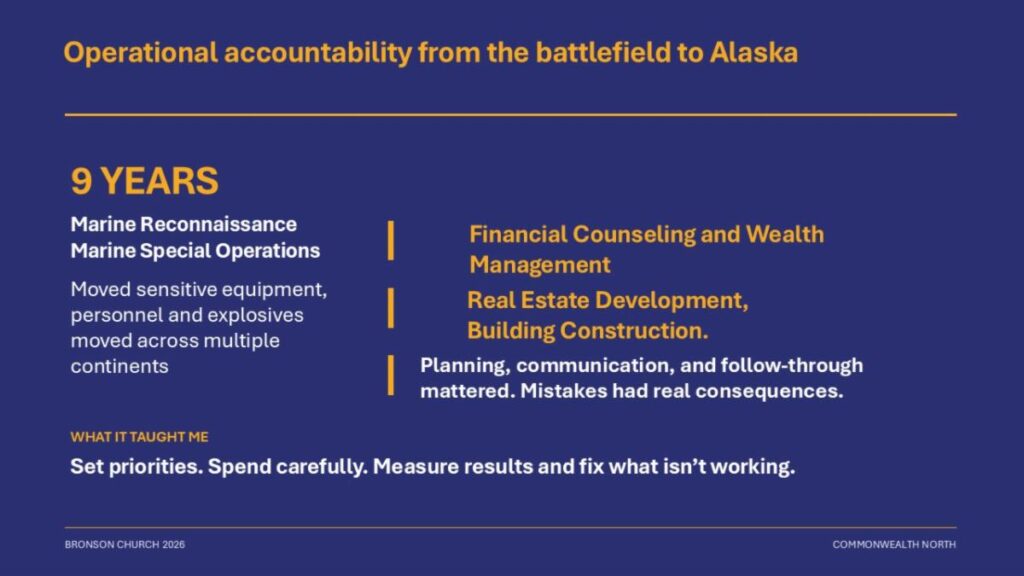
Church reached back to nine years in the Marine Corps, first in reconnaissance and then in Marine Special Operations, where he handled logistics for a small team deploying across continents. Aircraft, explosives, equipment, cash for training ranges. “Millions of dollars,” he noted, “which on the state level is actually fairly small.” His argument was less about the dollar figure than the discipline: he built the budget, spent it, and watched it through to the end. He added two decades of homebuilding in the Interior, starting at 14 framing houses, and six years as an investment advisor with Arbor Capital in Fairbanks.
He also offered the forum’s most unexpected analogy. The Division of Elections, by his count, has about 15 people. On election day they are responsible for roughly 400 communities. “You have to be prepared with a small team to expand your influence over the entire state,” Church observed, which is how he described the structure of a special operations unit. He said he would try to visit all 402 voting communities.
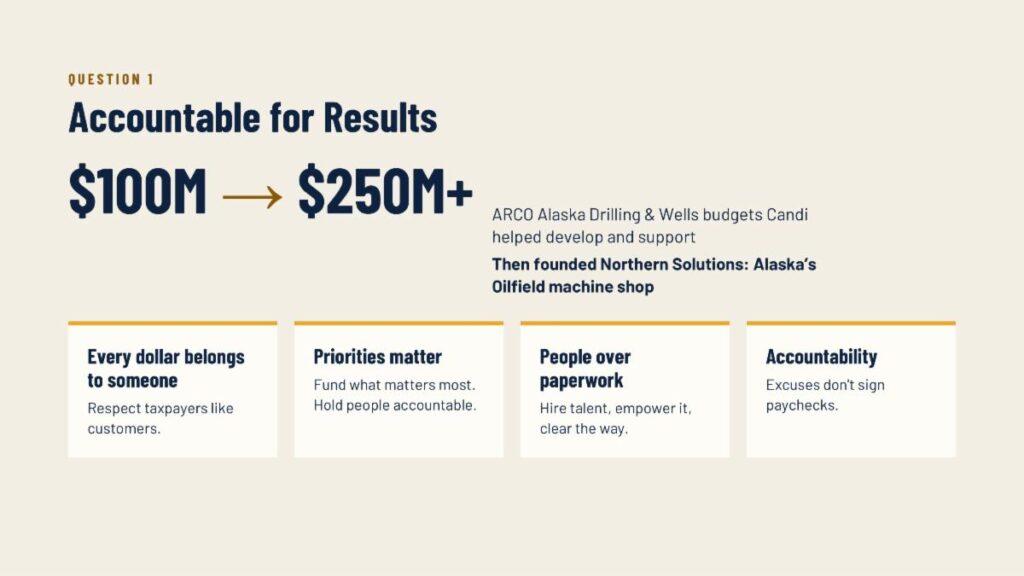
English spoke from 20 years with ARCO Alaska in the drilling and wells group, where she helped develop operating and maintenance budgets that grew from roughly $100 million to more than $250 million inside unit operating agreements and multi-owner oversight. After retiring she founded Northern Solutions, which she described as Alaska’s largest machine shop, with a manufacturing facility in Anchorage and a support shop in Deadhorse. She organized her remarks around four lessons, and the fourth landed hardest.
“Excuses don’t sign paychecks. I do.”
Johnson had the only budget in the room that resembles state government. The Anchorage Assembly, where he is serving his second term, oversees what he called the second-largest governmental budget in Alaska: $656 million for FY2026. His slides showed roughly 60 percent of it going to police, fire, and maintenance and operations, which he offered as a rough parallel to the state’s own priorities. His central claim was that Anchorage, operating under a tax cap that leaves it with essentially the same inflation-adjusted budget as 40 years ago, has nonetheless improved services in recent years: a police department approaching full staffing, a municipal prosecutor’s office, better plowing, fewer people sleeping outside. His specific example was a 2024 amendment he sponsored to fund an already-negotiated police raise that had never been programmed into the budget.

The Division They All Want to Fix
On elections, the three candidates converged on the diagnosis and diverged on the prescription.
All three said the problem is trust. Church pointed to declining turnout and rising distrust of institutions. English called the current state of confidence “kind of a mess” and insisted it is “not a Republican or a Democrat issue, it’s an Alaskan issue.” Johnson framed the lieutenant governor’s role as one of restraint: “not to impart my views or my partisan lens on any sort of decisions, but to empower the department to make good decisions.”
The remedies sorted differently.
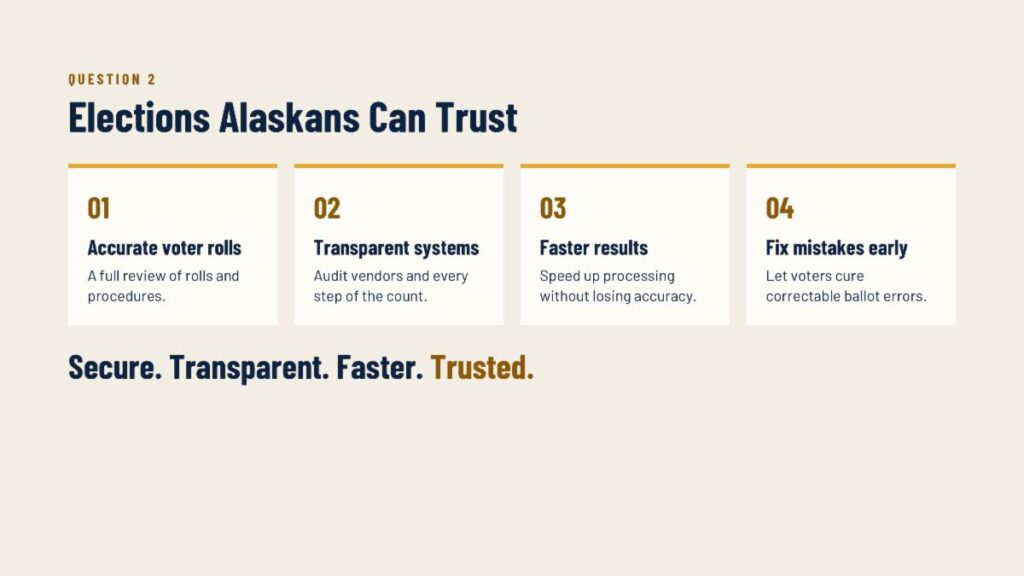
English laid out four priorities in order. A thorough review of voter rolls and procedures. Audits of third-party vendors and every step of the count. Faster results without sacrificing accuracy. And ballot curing, so that absentee voters can fix correctable signature or identification errors before their ballot is rejected. She also argued the Division has an education job to do on Ballot Measure 2 itself, noting that the 2024 repeal attempt failed by roughly 740 votes and that many voters said afterward they were not sure which way they had voted.
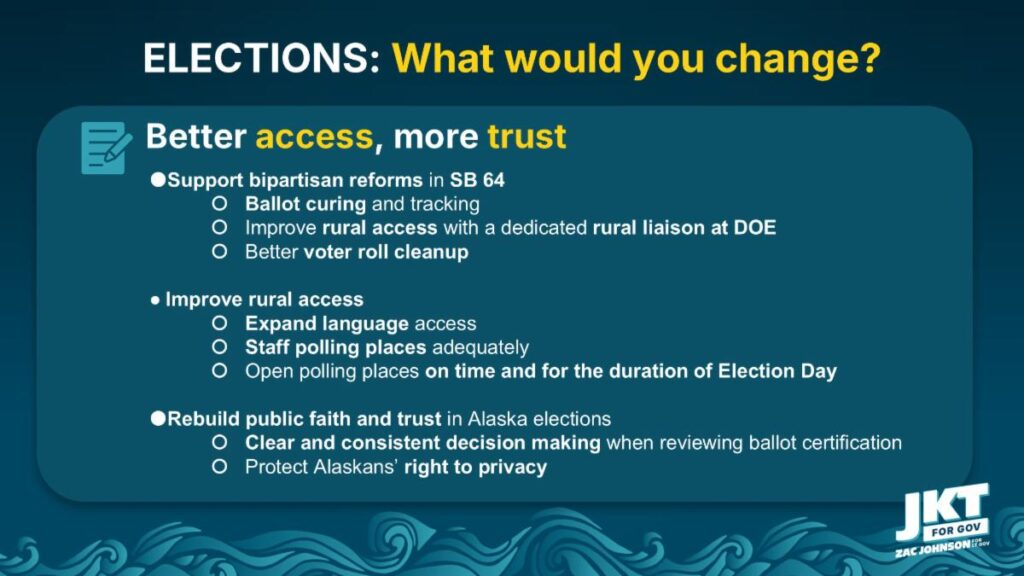
Johnson anchored his answer to Senate Bill 64, the bipartisan election bill the legislature passed this year and the current governor vetoed. Kreiss-Tomkins would have signed it, Johnson stated. He listed what it contained: ballot tracking so voters can see where their ballot is in the system, ballot curing, a dedicated rural liaison at the Division, and voter roll cleanup. Beyond the bill, he emphasized language access, adequately staffed polling places, and protecting the constitutional right to privacy.
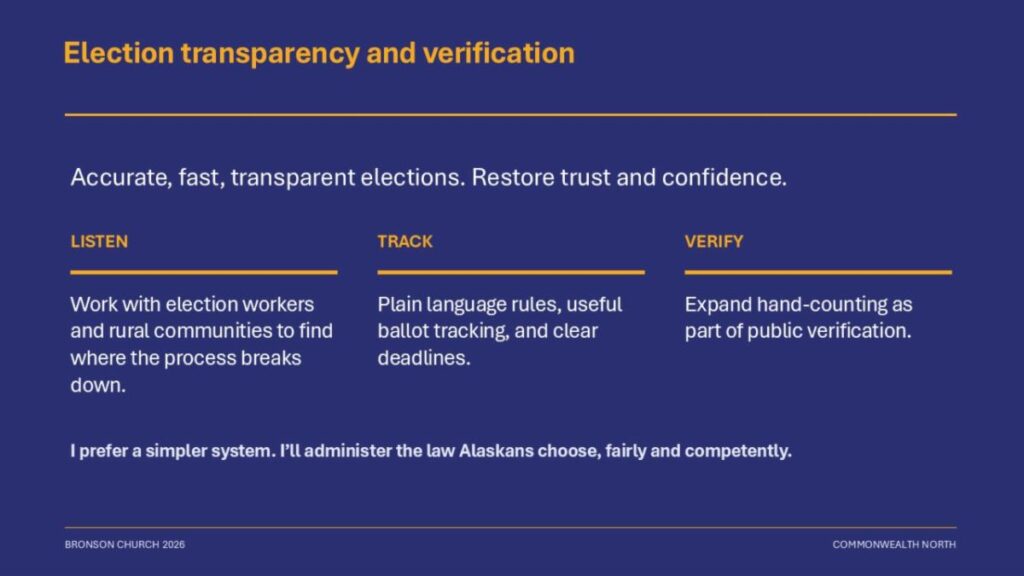
Church’s spoken remarks stayed at the level of principle: transparency earns trust, and transparency comes from presence. His slide deck went further than his eight minutes allowed, calling for plain-language rules, useful ballot tracking, and expanded hand-counting as part of public verification. He did not get to the hand-counting point aloud, so it went unexamined in the forum.
When the rural voting question came, the three answers were a study in approach. English picked one thing: mail reliability, because it hits rural Alaska hardest. Johnson declined to pick, arguing the issues are interrelated and that an administration should “walk and chew gum at the same time.” He then offered the forum’s two most specific anecdotes: a precinct where polls did not open until 5 p.m. this year, and a voter in Naknek whose ballot was mailed on time, routed to Anchorage, sent back to Nome for counting, and arrived too late to count. His conclusion was that ballots should be counted closer to where they are cast. Church drew on cross-cultural work in the Marines and borrowed a metaphor from Johnson’s trooper career: ballots deserve “the same level of care and trust as Zac would with evidence.” A chain of custody from the moment of voting to the moment of counting.
The Measure on the Same Ballot
The first question of the lightning round went straight at the awkward fact of this race. If Ballot Measure 2 passes, the next lieutenant governor unwinds ranked choice voting before 2028. If it fails, the next lieutenant governor administers it.
Church called it “a really easy one.” The job is to enforce the law transparently, whichever law voters choose. He spent the rest of his minute praising his opponents.
English said she would manage a transition professionally if the measure passes, and educate voters on the system if it fails. “My job isn’t to pick winners.”
Johnson was the only one to state his own vote. “I am a fan of ranked choice voting, and especially as an independent, open primaries. It’s a system that allows me to fully participate. So I will be a no on Prop 2.” He then said what the other two said: the lieutenant governor’s obligation is to the will of the voters, and if the measure passes, the system gets rolled back in good faith with professional staff and early preparation.
Church’s deck, for the record, stated his personal preference for “a simpler system,” though he did not say so aloud. English did not share a personal position during the forum.
The Assignment
The day-one question is where the three campaigns revealed their priorities most clearly, because each candidate asked for something different.
Church wants public assets. Land sales, permitting reform, and above all the Permanent Fund. He argued that a $90 billion fund managed in line with peer institutions would pay roughly a third of a percent in fees, against the more than one percent, or $890 million, he said Alaska paid last year. He characterized the fund’s roughly 8 percent long-run return as “a C student” relative to best-in-class peers and claimed an A-student performance would mean about $3 billion more a year for the treasury, enough to close the fiscal gap. His fix: professionalize the board with investment experience. None of those figures were sourced or examined during the forum, and they deserve scrutiny before anyone builds on them. But as a statement of what he would spend his time on, it was the most specific answer of the afternoon.

English asked for a statewide competitiveness and economic opportunity initiative aimed at the problem she identified as Alaska’s largest: keeping people here. Four components: affordable energy, infrastructure, housing, and workforce development. “Economic growth isn’t abstract,” she noted. “It’s whether a family can afford groceries.”

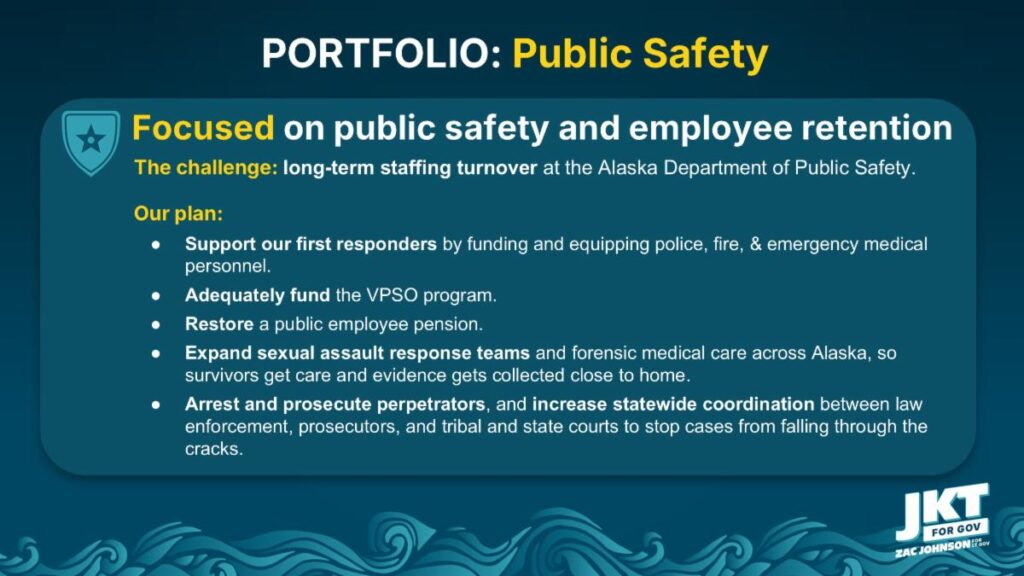
Johnson asked for public safety, and his answer carried the weight of eight years as an Alaska State Trooper. He was hired in 2013. By the time he left, two-thirds of his hiring class was gone. There were about 50 vacant trooper positions in 2013, he stated, and about 50 today. His prescriptions: restore a defined benefit pension, fund the VPSO program he relied on in rural Alaska, expand sexual assault response teams so evidence is collected close to home, and tighten coordination among law enforcement, prosecutors, and the courts.
If the Phone Rings
Two of the lightning questions tested the succession scenario directly. What would you do if you had to take over midterm, and how would you close a budget gap in one session?
On succession, the answers rhymed. Johnson emphasized a collaborative campaign in which he has been “an intimate part since the beginning,” and named his first priority as repairing the relationship between the legislature and the executive branch. Church said he has written the majority of the Bronson campaign’s policy plans and could “step right in.” He added a candid aside about his running mate: Bronson “learned that you need an assembly to work with you as mayor,” and “he’s not a business guy. So he brought me on.” English promised continuity. “We have one agenda that Alaskans voted for.”
On the budget gap, the split was visible. Church and English both said they would start with spending. Church described a zero-based budget, which he said Alaska has never done, reviewing every department line by line in the first year. English added “activity-based” to zero-based and said the sequence would be: identify what is constitutionally required and essential to public safety and education, build the budget from there, and find efficiencies “before we ever ask taxpayers for more money.”
Johnson, who described his ticket as “very pro-math,” committed to delivering a balanced budget to the legislature, which he said would be a first in nearly a decade. He then named two revenue measures: a corporate tax modernization along the lines of Senate Bill 113, also vetoed this year, to capture taxes from large online retailers, and extending oil and gas taxation to S-corporations so that “all should pay their share.”
The Predecessors
The final question asked which former lieutenant governor each candidate most admires. It was meant to be the soft one. It turned out to say a great deal.
English chose Keith Miller, the man Bittner had named in his opening as the first second-in-command to finish a governor’s term. She noted that Miller presided over the first Prudhoe Bay lease sale, which brought in $900 million, and proposed an investment fund for oil royalties that eventually became the Permanent Fund. What she admired was that “he thought about the next generation, not the next election.”
Johnson named two. Fran Ulmer, for modernizing Alaska’s election system in the 1990s: “When we were talking about hanging chads back in 2000, Alaska had already fixed that problem.” And Jack Coghill, a conservative who signed the Alaska Constitution as a convention delegate and, in Johnson’s telling, was outspoken about working with the minority.
Church admitted he had struggled with the question. He mentioned Parnell and Loren Leman, then landed on the same name Johnson had. “I’m surprised there’s another thing Zac and I agree on. Jack Coghill.” Coghill was from the Interior, as Church is, and Coghill’s son John, a former legislator, has endorsed the Bronson ticket.
Two Marines from rival tickets, asked to name a hero, picked the same 1955 constitutional delegate.
What the Hour Showed
The lieutenant governor’s office is a strange one. Its only fixed duty is the one most likely to be contested, and its other duties are whatever the governor hands over. The three candidates who showed up on Wednesday each described a different second job: one wants the Permanent Fund, one wants economic competitiveness, one wants the troopers. Voters choosing a governor in November are also choosing which of those portfolios gets a champion in the administration, and which person stands next in line.
On the fixed duty, the candidates agreed more than their tickets might suggest. All three promised to administer whatever election system voters choose. All three want faster counts, cleaner rolls, and a chance for voters to fix mistakes. The differences were in emphasis and in how much they were willing to say about their own preferences.
Church used part of his first lightning-round minute to say something rarely heard in a candidate forum. “I like this slate of lieutenant governors better than I do the governor candidates.” He was including his own ticket’s opponents, and by implication his own running mate, in the comparison. Bittner let it pass without comment and moved to the next question.
Early voting is open now. Election Day is Tuesday, November 3. Bittner’s closing instruction was the only endorsement Commonwealth North offers: “Whoever you vote for, we don’t care, just get out and vote.”
This summary is a recap of the information presented. It is not an official record, transcript, or position statement. The content reflects only the views and statements made by the individual presenters and participants at the time of the forum. It should not be interpreted as representing the official views, opinions, policies, or positions of Commonwealth North, its leadership, board members, staff, or affiliates.
Reference materials