What's New
Exit Interviews: What Alaska’s Commissioners Want the Next Governor to Know
Alaska’s departing commissioners & counsel sat for an exit interview in public. What they left behind was less a victory lap than a to-do list with deadlines already attached.
In the private sector, an exit interview happens in a small room with someone from human resources and a box of tissues. Commonwealth North held one on the record in front of Alaska’s most engaged citizens.
Thirty-four days.
At most new jobs, Kris Knauss, our moderator, observed, five weeks is about how long it takes to find the good coffee and figure out who actually knows how things work. Alaska’s next governor gets five weeks to learn all of state government, on one of the shortest transition timelines in American politics. So the forum was framed not as a retrospective but as a working session on continuity of government, held in public before the clock starts.
Five people who have run the machinery of the state over the past eight years took the microphone in turn: Deena Bishop, commissioner of Education and Early Development; Doug Vincent-Lang, commissioner of Fish and Game; Ryan Anderson, commissioner of Transportation and Public Facilities; Heidi Hedberg, commissioner of Health; and Stephen Cox, counselor to Governor Mike Dunleavy and the state’s acting attorney general from August 2025 to May 2026. Each had twelve minutes and three questions: What are you most proud of? What do you wish you had solved? What should the next administration know?
The answers, taken together, sketched a state government that spent much of the past four years fixing its own plumbing, and now hands the wrench to someone else with several pipes still open.
Cleaning House
Hedberg was the most candid about this. “A lot of what you heard me say was four years of cleaning up our house,” she told the room near the end of her remarks. She did not mean it as a complaint.
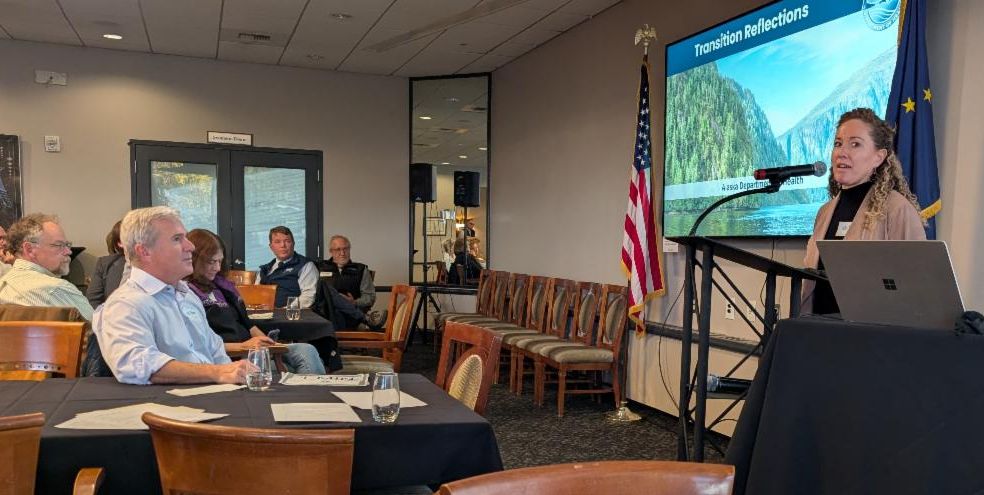
When she became commissioner in late 2022, the former Department of Health and Social Services had just been split in two. Hedberg called the old agency “a beast,” an organization so sprawling that no single person could know its depth in a 24-hour day. The reorganization left her with five divisions, each built around a system: public health, behavioral health, Medicaid, seniors and disabilities, and public assistance. Only with that smaller span of control, she argued, could anyone lift the hood and see what was actually broken.
A good deal was. Coming out of the pandemic, the department had suffered a cyber attack. Public assistance offices were closed. Alaskans were not receiving food benefits.
“It was an experience I lived publicly for many, many years,” Hedberg said.
The numbers she offered on Wednesday are the kind that only make sense against that baseline. Four years ago, a SNAP application took roughly twelve months to process. Today the average is 47 days. The federal standard is 30, so the department is not yet where it needs to be, but the distance traveled is considerable. Every public assistance office is now open. The vacancy rate in field services, which Hedberg checked a few weeks ago, sits below 10 percent. Applications have moved online and been consolidated into a single smart form. For communities with no office at all, the department can send a traveling team she calls “DPA in a box.”
Hedberg’s other point of pride began three weeks into the job, when a report from the U.S. Department of Justice landed on her desk concerning the unnecessary institutionalization of Alaska youth in behavioral health facilities in the Lower 48. The department responded with listening sessions and a Youth Behavioral Health Roadmap. Last week, she said, the Justice Department closed the case, citing a decline in the number of young Alaskans sent out of state and an expanding continuum of care at home. In Anchorage, Southcentral Foundation and Providence are building 23-hour stabilization centers so that a person in acute distress has somewhere to go that is not an emergency department.
Cox, who worked on the same matter from the attorney general’s office, added in a detail. The federal investigation rested on a guidance document the Civil Rights Division had issued after the 1999 Olmstead decision, guidance that, in Cox’s reading, went beyond what the Supreme Court actually held and was being used against states across the country. Alaska pushed back on the guidance itself, in partnership with federal officials, and the case closed. Two departments, one problem, solved from opposite ends.
The Reading Numbers
Dr. Deena Bishop, a former math teacher, opened with a confession about the department she inherited. Alaska’s Education Challenge, the statewide planning effort launched under Governor Bill Walker, had produced a set of priorities that most Alaskans could agree with. What it had not produced, she found, was any way to know whether the state was achieving them.
“All we had in the department were statements,” she said. “How do you know? Where are we?”
The answer, under the State Board of Education, was a set of measurable goals, adopted this year, with 2026 baselines and 2029 targets: grade 3 reading proficiency up five percent, K-3 literacy screener results up ten percent, chronic absenteeism down six percent, and so on. Every program and grant in the department is now meant to point at one of them. Bishop described a real example of why that matters: a school in the bottom five percent statewide for reading and math whose federally funded improvement goal was gardening.
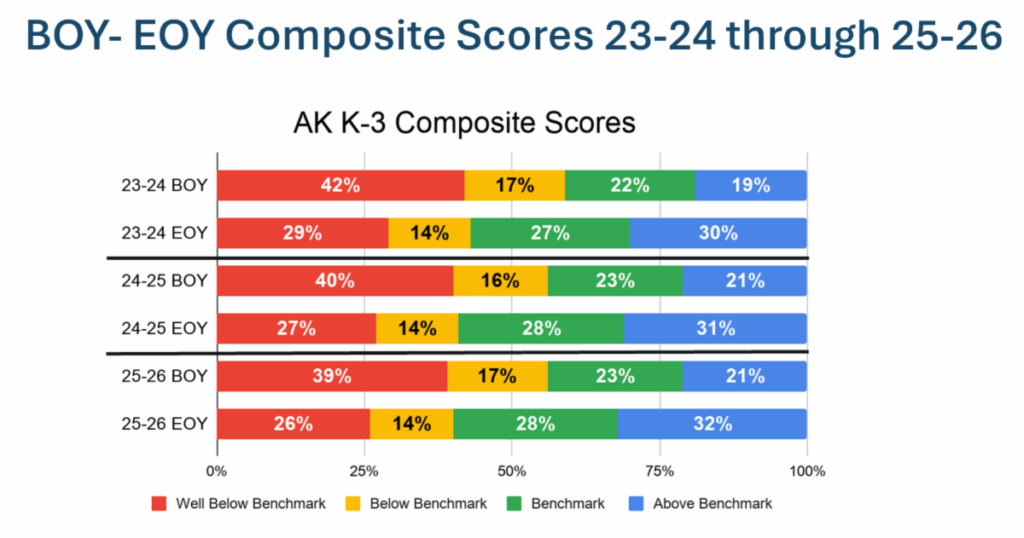
The clearest data of the afternoon came from the Alaska Reads Act, which Bishop called the most significant piece of education legislation of her lifetime. Passed in 2022, the law requires K-3 teachers to be trained in the science of reading, mandates early screening, and prescribes phonics-based materials.
In the 2023-24 school year, 42 percent of Alaska’s K-3 students arrived in the fall two or more grade levels behind in reading. This past year that figure was 39 percent.
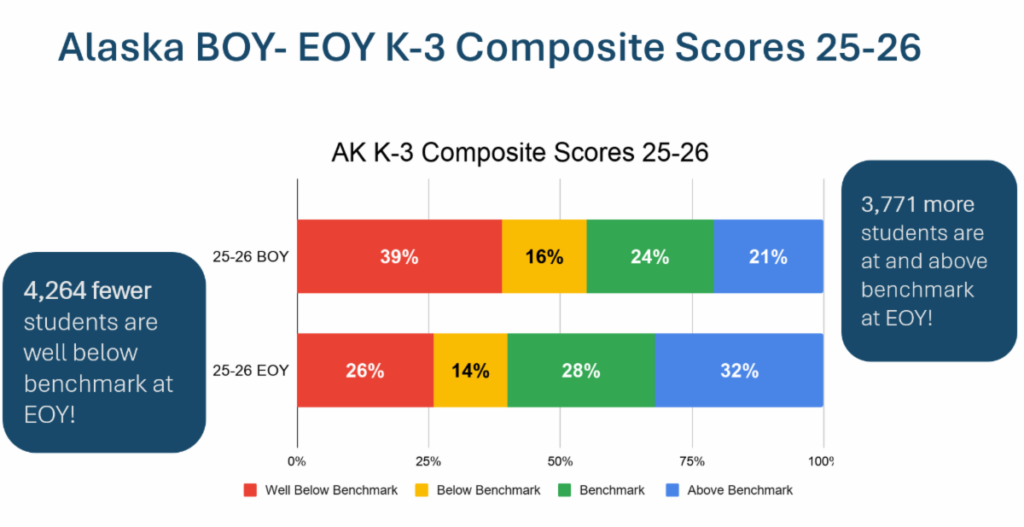
That sounds modest. The year-over-year movement is not. Between the beginning and end of the 2025-26 school year, 4,264 fewer students were in the “well below benchmark” category and 3,771 more were reading at or above grade level.
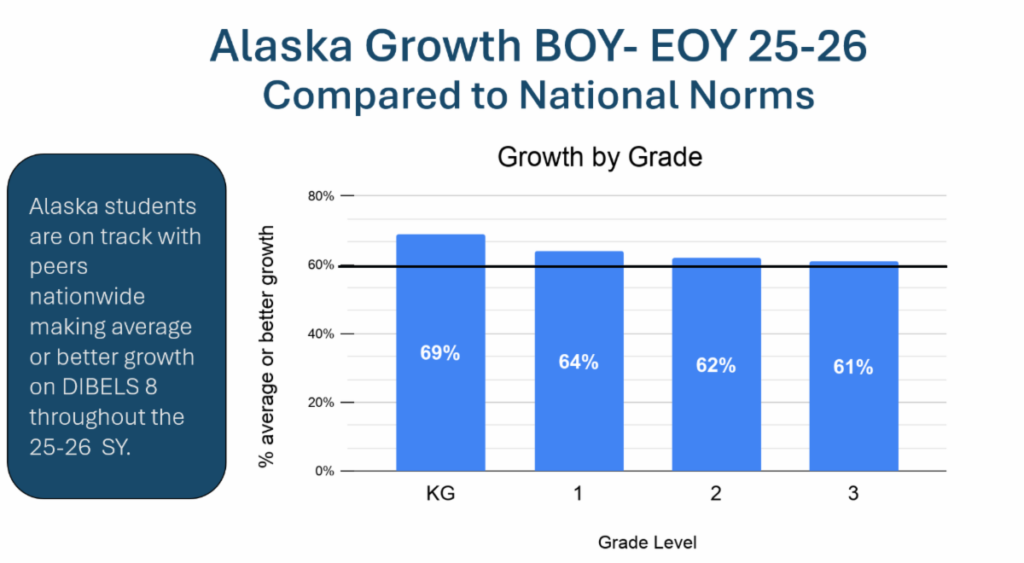
On the DIBELS assessment, which is normed against more than 20 million students nationally, Alaska’s children are growing faster than the national average. Bishop called it catch-up growth. It is the first time in years the state has had reason to use the phrase.
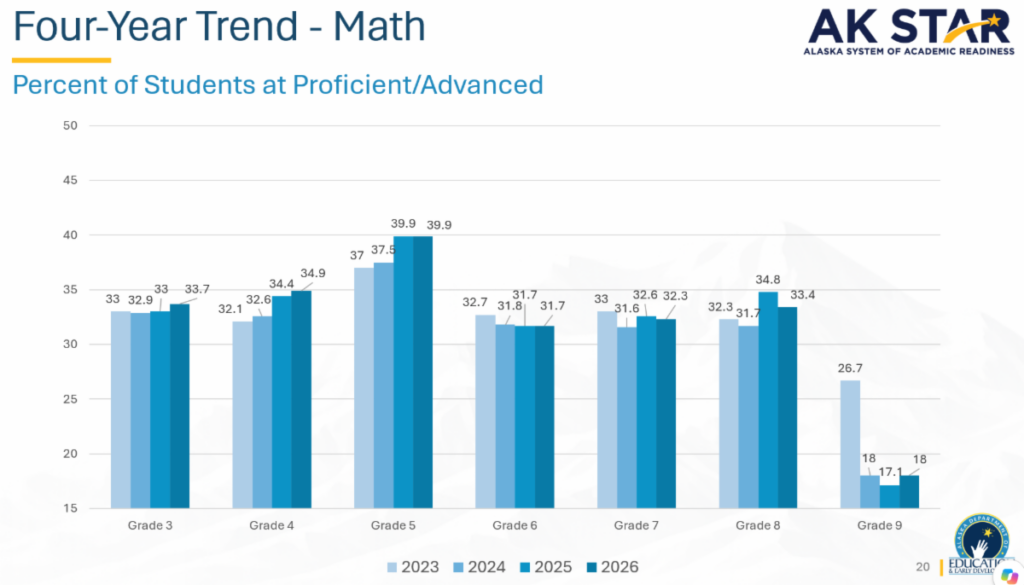
Bishop was equally direct about where the gains stop. The state’s AK STAR summative assessment shows movement in grades 3 through 5 and almost none above that. Math in the upper grades has slipped. Ninth-grade math proficiency fell from 26.7 percent in 2023 to 18 percent in 2026, according to her slides. “Still almost little to no growth in our upper grades,” she said. “So we publicized that.”
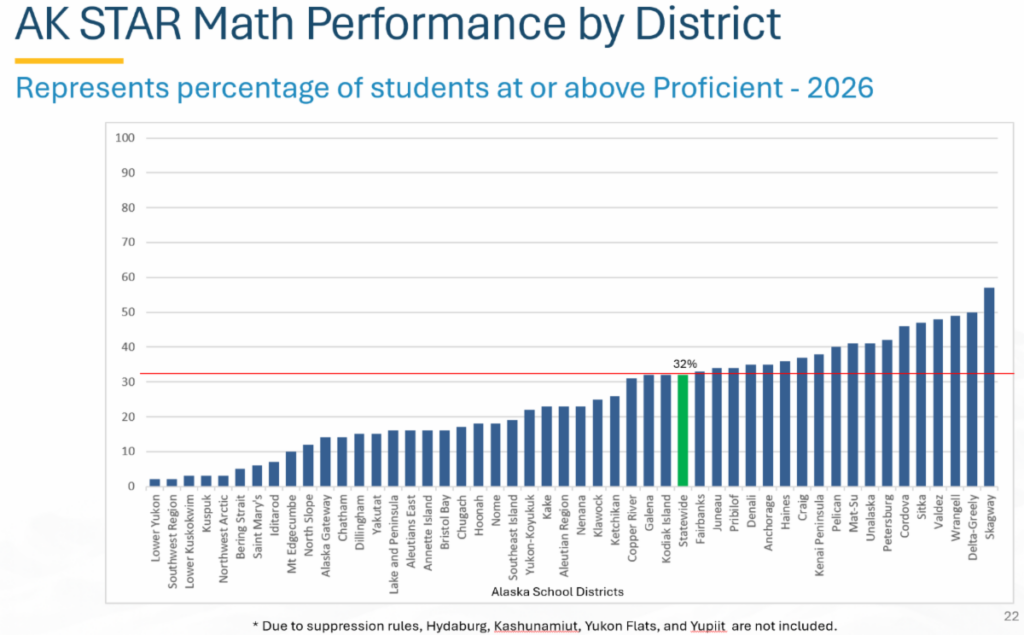
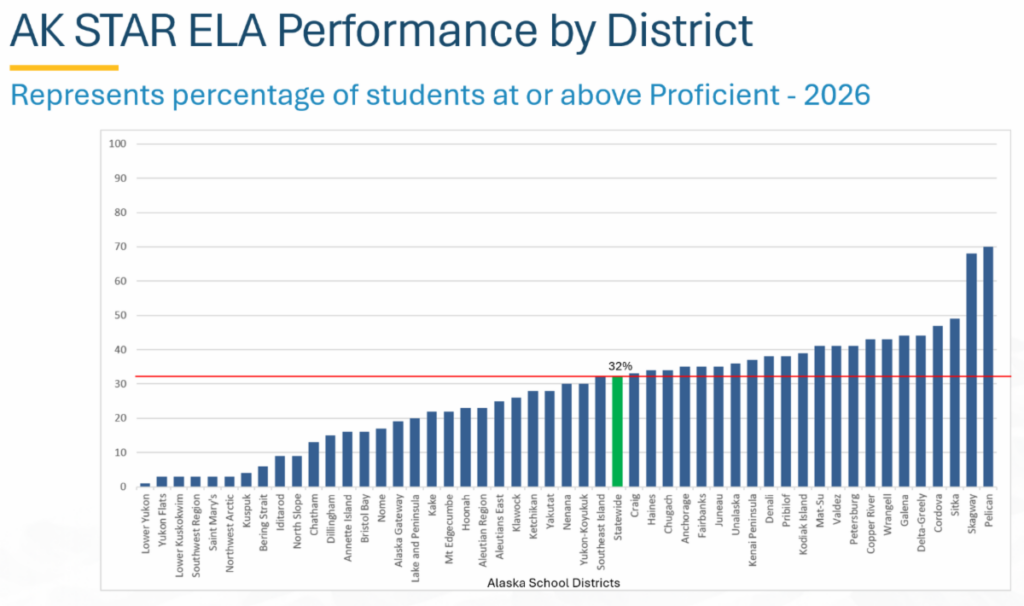
Publishing district-by-district results, she noted, was itself a departure. Superintendents used to compile those comparisons themselves because the department would not.
One figure Bishop raised deserves more attention than her time allowed. Energy costs come out of school districts’ operating funds, and her own survey found the range runs from $675 per student in the cheapest district to $3,600 per student in the most expensive. Every dollar of that difference is a dollar not spent in a classroom. House Bill 28, she said, would reimburse districts for energy costs based on a three-year average, subject to appropriation. It was the only cost driver she singled out by name.
The Fish That Came Back
Vincent-Lang started at Fish and Game in 1981 as a sport fish biologist.
His eight years as commissioner were defined, in his telling, by the decision to look at salmon in the ocean rather than only in the rivers. When he arrived, the department understood freshwater systems well and marine survival hardly at all. A new marine science program, a genetics lab he described as world-class, a research vessel donated by Trident Seafoods and retrofitted by the state, and a multi-year study of pink salmon hatchery straying have begun to fill that gap.
The Yukon is where the approach produced its most visible result. Eight to ten years ago, Vincent-Lang said, 30,000 to 40,000 king salmon were returning to the river. Rather than manage year to year, the state signed a seven-year agreement with Canada to rebuild the run across a full life cycle. This year, 110,000 kings came back.
He listed other things with evident satisfaction: wood bison transplanted to Innoko and Minto with Yukon Flats next, fifteen to twenty new boat launches, shooting ranges, a mobile app for licenses and regulations, cross-border agreements on transboundary mining and the Fortymile caribou herd that survived even the current tariff friction with Canada. He also noted the state’s success in getting the federal definition of “harm” under the Endangered Species Act narrowed, so that a habitat change today that might affect a species decades from now no longer counts as a take.
Then he turned to what he could not fix, and his tone changed.
“The one thing I wish I could have solved is the increasing distrust that the public has in the Board of Fish process and the Board of Game process,” he said. The average Alaskan, in his view, no longer feels that a proposal submitted to those boards gets a fair hearing. That matters more in Alaska than almost anywhere, he argued, because the fight for local control of fish and game was one of the reasons Alaskans wanted statehood in the first place.
On trawling, which he said has become “a governor’s issue” driven more by Facebook than by data, he offered the next administration an uncomfortable fact: roughly 70 percent of the economic value of Alaska’s fish harvest comes from federal waters three to 200 miles offshore. “Just ending trawling isn’t the answer,” he said. The answer, in his view, is observer coverage and making sure pelagic gear is fished off the bottom.
And then there was the bear. Two days before the forum, Vincent-Lang got a call about a bear inside a hospital. The department got it out. It came back twice the next day, and the department shot it. “I thought bears was an issue in rural environments,” he said. “No, it’s not. It’s an issue in urban environments.” The controversy over shooting bears is large, he acknowledged, but the alternative is bears in hospitals.
Potholes and a Billion Gallons
Anderson joked that potholes and snowplowing seem to be the whole job, and that when something goes wrong anywhere in Alaska’s transportation system, his is the first phone that rings.

The system he described is doing things most Alaskans never see. Ted Stevens Anchorage International Airport is now the third-busiest cargo airport in the world, up from fourth, and first in the United States. Cargo volume is growing five to seven percent a year. This year the airport will deliver close to a billion gallons of fuel to aircraft, a figure Anderson offered as a reminder of how much happens behind the scenes to keep what he called the global gas station running. Southwest Airlines began service last year. More route announcements are coming next week.
The department is putting more than a billion dollars a year into highways. The FAA contributes another $300 million annually to rural airports. For the Alaska Marine Highway, Anderson said the state has secured more than a billion dollars for new vessels and terminals built to interoperate, and he was frank about his own preference for building roads to shorten ferry runs and cut operating costs.
Disaster response has become a core function almost by default. Southeast landslides, Typhoon Merbok on the west coast, and Typhoon Halong this past year all put DOT crews and contractors on the front lines, in part because the department holds the state’s construction contracting authority. “We’ve been out there the whole year,” he said of the Halong recovery. “A lot of people don’t see that. And that’s kind of the way we like it.”
Anderson’s unsolved problem is one he has watched for his entire 26-year career: project delivery. Permitting reform and regulatory reform get discussed endlessly, he observed, and the department solves one obstacle only to find another. Right now, acquiring right of way for projects in downtown Anchorage under federal rules is the bottleneck. Workforce is the other constant. When a big project like the Nome port draws away equipment operators, the department ends up flying people in on two-week rotations.
His advice to the next team was partly a warning. The department has big, controversial projects in motion. Before shutting any of them down, he asked, understand how each came to be, who the partners are, and how much has already been invested. “We’ve seen over the years where things go back and forth. They get shut down, then they get started up. There’s a lot of time and a lot of resource in that.”
He also flagged artificial intelligence as a topic that will be “very big” over the next four years for every agency. He was the only speaker to raise it.
The Lawyer’s Ledger
Cox organized his remarks around a single word, partnership, and then illustrated it with a case that had been stuck for more than a decade.
The Port of Alaska litigation dated to a botched federally managed expansion project begun in 2002. The Municipality of Anchorage sued in the Court of Federal Claims around 2012. There was a trial, an appeal, a remand, and the prospect of a second trial, with the federal government insisting it owed nothing and the city claiming roughly half a billion dollars. No settlement talks had ever been possible.
Because Cox was already working with the municipality on public safety, the city asked for help. The governor agreed, on the theory that what helps the city helps the state. In early April, Cox said, the state presented its theory of the case to the Justice Department for the first time, along with an offer. He worked back channels with former colleagues to make sure the response was a serious one. Within two or three months, the case settled for $180 million.
“That’s way beyond what anybody at the federal level thought would ever be paid,” he said.
On Anchorage crime, Cox described a problem that everyone acknowledged and no one owned. The law department said it was not an investigative agency. State troopers said downtown Anchorage belonged to the Anchorage Police Department. His response was to put everyone in one room: a task force with the city attorney’s office, APD, the Department of Health, the Department of Law, and the Department of Public Safety. City prosecutors were cross-designated to bring state felony charges, particularly in retail theft. Walmart was brought in to talk about information sharing. A new agreement with the Justice Department will place special assistant U.S. attorneys who split their time between state and federal cases.
The problem he could not solve is the one he urged the next administration to take up. A significant number of criminal defendants in Anchorage are found incompetent to stand trial, often because of mental illness or intellectual disability, and the system has nowhere to put them. Alaska allows 90 days to restore competency, extendable to a maximum of 360 days for the most serious offenses. Cox said that is the shortest window in the country. The clock starts when the judge signs the order. The Alaska Psychiatric Institute has about ten forensic beds and a waitlist of roughly 120 days.
“You’ve eaten through that entire first or second stage of restoration,” he said. The defendants cycle back onto the street, and the standards for civil commitment, which require a showing of recent harm, do not reach them. His recommendation was blunt: more capacity, and possibly a state hospital.
He closed on regulatory reform. Under an administrative order modeled on Governor Glenn Youngkin’s program in Virginia, the state is on track to eliminate more than 1,000 regulatory requirements, many of them out of step with statutes that changed decades ago.
He hoped the work would continue.
The Clock the Next Governor Inherits
If the first half of the afternoon was a ledger of things fixed, the second half was a calendar.
Hedberg’s slide titled “For the Next Administration” was the most specific. Federal legislation passed last year, which she referred to as H.R. 1, changed Medicaid and SNAP in ways that land squarely in the transition window. Alaska’s Medicaid expansion population, about 47,000 people, must now have eligibility renewed every six months. That began October 1 for the January cohort. Hedberg has the same number of staff and a better IT system, but she said plainly that the department is not ready yet.
The SNAP piece carries a price tag. Alaska’s payment error rate stands at 20 percent. The state must get it below 6 percent by the end of this calendar year, a deadline the congressional delegation negotiated into the bill, or the new administration will owe roughly $45 million toward benefit costs beginning in 2030. “The work changes have to happen this year,” she said. “This year is critical.”
Then there is the Rural Health Transformation Program, about $1.3 billion over five years to change how care is delivered in rural Alaska. A strong team is working it, Hedberg said.
Vincent-Lang’s calendar is international. Alaska is entering negotiations on the next ten-year annex of the Pacific Salmon Treaty with Canada. In the last two annexes, he said, the state gave up a good deal of fish to southern fisheries. “We’re not gonna do that this time, at least if I have anything to say about it.” The next governor will be the one who has something to say about it.
Bishop’s was fiscal. The state will send $1.48 billion in operating aid to school districts in fiscal year 2027, plus roughly $124 million in capital, most of it for major maintenance. Her message was that an investment of that size deserves a return, and that the department now has the goals to measure one.
Cox noted that the governor has directed an orderly transition: a status quo budget, no new legislation, and a clear plate for whoever comes next.
Speed Dating and a Note on the Desk
Hedberg remembered walking into the role as commissioner with no transition plan and a media that knew the public assistance problems before she did. “It was really humbling,” she said. “The gift that I give now is a really good, solid transition plan that you can continue to refer back to.” Several of the others said they are writing the same.
One of the commissioners mentioned that he had been printing something that morning. A note, to leave on the desk for whoever comes next. Build trust with the Legislature, it said. Take the opportunity. Spend time down there.
Cox, who arrived in Alaska about five years ago, offered a sentence that drew knowing laughter: “Fish politics are the worst.” He meant it as a plea for education, not an escape. “I love this state. We’re here for good.”
Another commissioner wished for a month, before the fire hose turns on, simply to walk the halls and meet staff. Instead, a new commissioner arrives with a list of issues from the governor and a line of people wanting things.
Asked how to handle the Legislature, Hedberg described confirmation as speed dating. She met all sixty legislators, sometimes to be interviewed and sometimes just to listen, and credited those relationships with much of what followed. Cox’s advice to his successor was to be candid and let the political chips fall. Bishop, whose position is filled by the State Board of Education rather than the governor, observed that she never got to speed date, but that the job is relationships all the same.
Asked whether they would serve on the next transition team if invited, the answers from the table were variations on yes. Vincent-Lang put it in terms the room seemed to appreciate: “We may not agree on what you’re going to do next, but I think having that discussion has to happen.”
The last word went to Eleanor Andrews, who held a commissioner’s post herself four decades ago. In her day, she recalled, new appointees who did not yet know where their offices were got a week of orientation: here is your job, here are the statutes that govern it, here are the people you will work with. “We’re still a small town,” she said. “We can know each other if you leave the partisanship at the door and just know what your job is.”
This summary is a recap of the information presented. It is not an official record, transcript, or position statement. The content reflects only the views and statements made by the individual presenters and participants at the time of the forum. It should not be interpreted as representing the official views, opinions, policies, or positions of Commonwealth North, its leadership, board members, staff, or affiliates.
Reference materials
- Department of Education and Early Development slides: “DEED, Commonwealth North Exit Interviews, October 15, 2026”
- Department of Health slides: “Transition Reflections, Alaska Department of Health, October 15, 2026”
If you find value in programs like this one, join Commonwealth North as a member.