What's New
Alaska’s Oil Tax Tightrope: What Barry Pulliam Says
A note to readers: This summary differs from a typical Commonwealth North forum. Our standard programming features multiple speakers presenting diverse and sometimes competing perspectives on a policy question. This was not that. The Alaska Oil and Gas Association (AOGA) hosted a presentation for Commonwealth North members by Barry Pulliam, Managing Director of Econ One Research, offering an industry-side analysis of Alaska’s oil tax structure and the potential consequences of SB 227. The data and arguments presented here reflect that perspective. Commonwealth North shares this summary in keeping with our mission to extend substantive policy conversations to a wider audience, while noting that a complete picture of Alaska’s oil tax debate would include viewpoints not represented in this particular session.
A proposed return to gross taxation would push Alaska’s severance rate to roughly four times the national average, just as new production is poised to reshape the state’s fiscal future.
ANCHORAGE, March 19, 2026 | AOGA Conference Room
Forum Summary by Ross Johnston, Executive Director
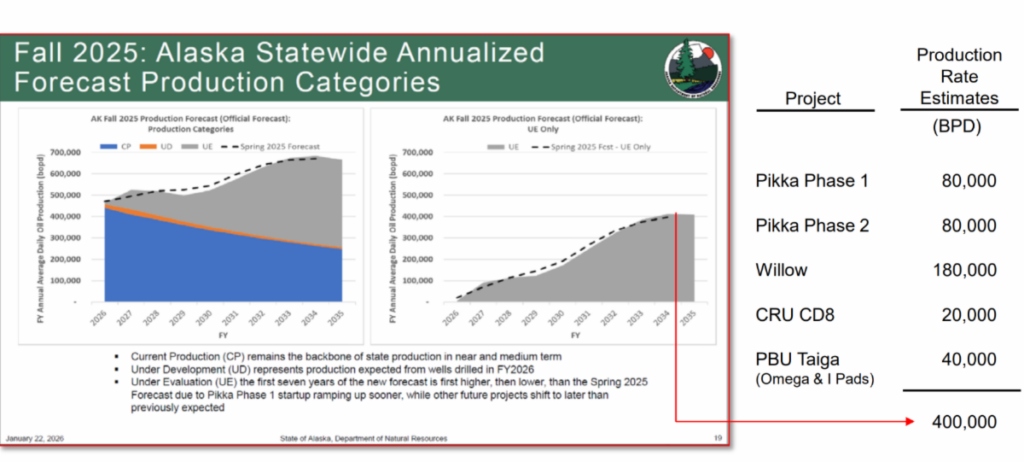
Four hundred thousand barrels a day.
That’s the volume of new North Slope production the Alaska Department of Natural Resources projects could come online over the next decade from Pikka, Willow, Colville River, and western Prudhoe Bay. It would represent the most significant expansion of Alaska oil output in a generation, the culmination of more than $14 billion in committed capital and years of regulatory navigation in one of the most challenging operating environments on earth.
Whether Alaska actually sees all of it depends, in no small part, on what the legislature does next.
Pulliam presented a concise but data-dense briefing on the economics of Alaska’s oil tax system, the historical relationship between tax policy and production investment, and the potential consequences of SB 227, which would replace the current net-profits-based system with a flat 17.5% gross severance tax. He has worked on Alaska oil and gas fiscal policy for more than 35 years, advising both the state and the legislature through every major tax regime change since the late 1980s.
The Good, the Bad, and the Ugly
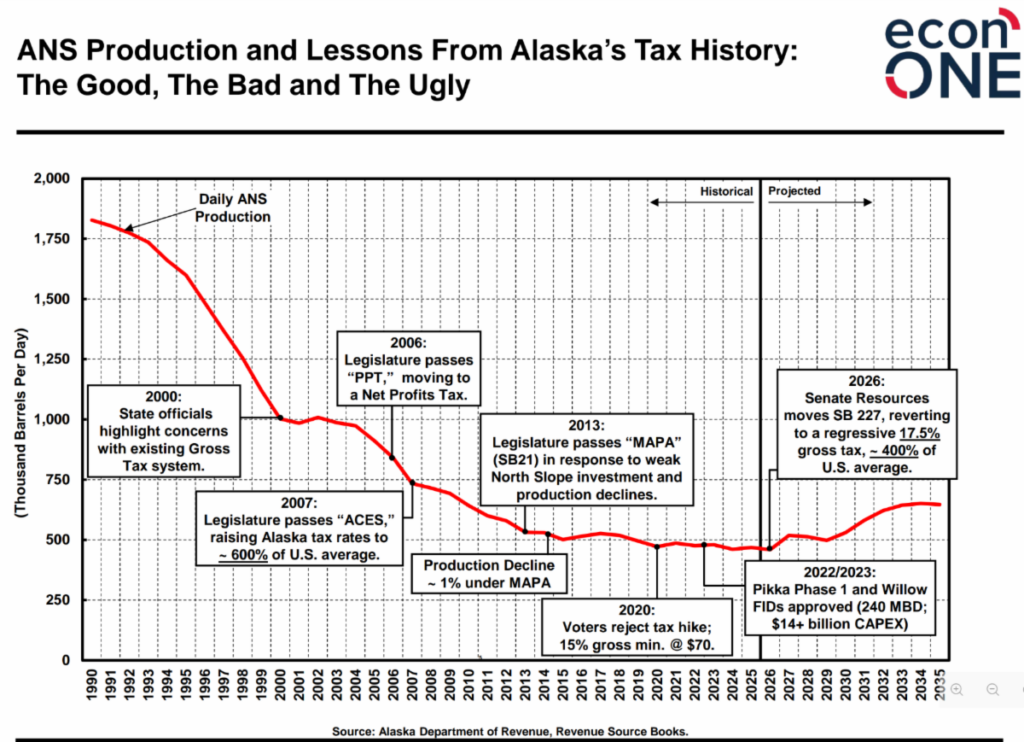
Pulliam organized his analysis around a timeline of Alaska North Slope production overlaid with the state’s tax policy shifts. He titled the chart, with characteristic understatement, “The Good, the Bad, and the Ugly.”
The good: In 2006, recognizing that the existing gross tax system was both regressive and failing to capture upside for the state at higher oil prices, the legislature moved to a net profits tax called PPT. The concept was sound. Tax the profitability of production, not just its gross value, and build in credits to attract investment back to Alaska.
The bad followed quickly. Just one year into the new system, dissatisfied with initial revenue returns, the legislature overhauled PPT into ACES, a highly progressive structure that, over its lifespan, produced an effective tax rate averaging roughly 25% of gross oil value. Pulliam noted that this was approximately 600% of the volume-weighted average severance tax rate in the Lower 48 states.
The ugly was what happened to investment. During the ACES years (2007–2013), North Slope production declined at 5.8% annually. Oil prices during that period averaged $92 per barrel. The forecast at the time projected a continued 5.2% decline even at $120 oil. Capital was flowing instead to the Permian Basin, the Bakken, and other shale plays where returns came faster and the regulatory and fiscal environment was more predictable.
One detail that didn’t receive enough attention at the time, Pulliam observed: at prices in the $90 range under ACES, a one-dollar increase in oil price returned just ten cents to the producer. The state and federal government captured the other ninety. There was, in practical terms, no upside left for the companies doing the drilling.
What MAPA Changed
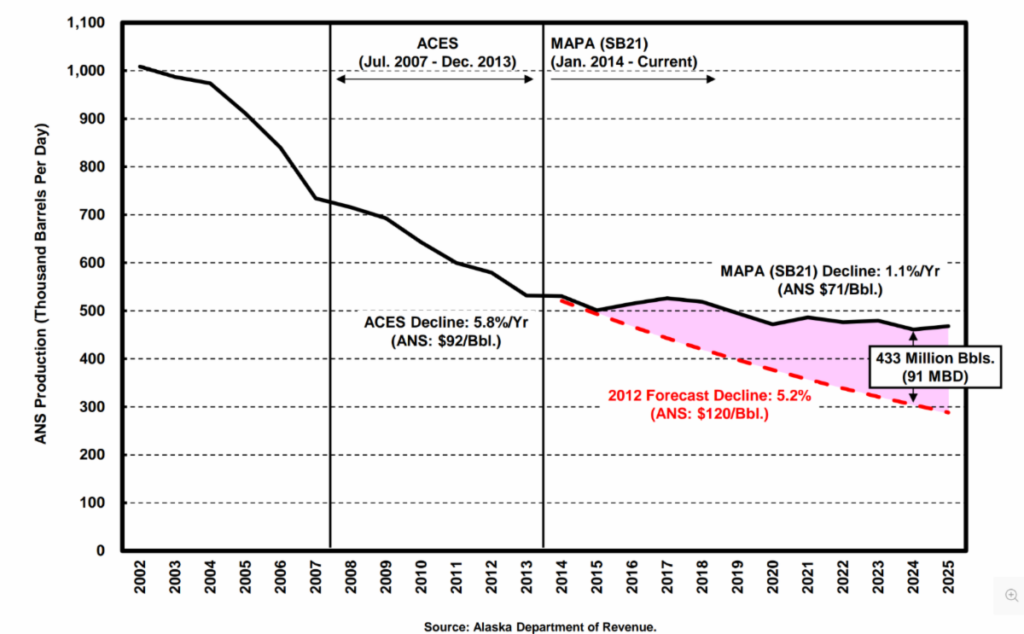
The passage of SB 21 in 2013, known as the More Alaska Production Act or MAPA, moved the system to a more balanced progressive structure. The tax rate still rises with profitability, but without the extreme progressivity that characterized ACES.
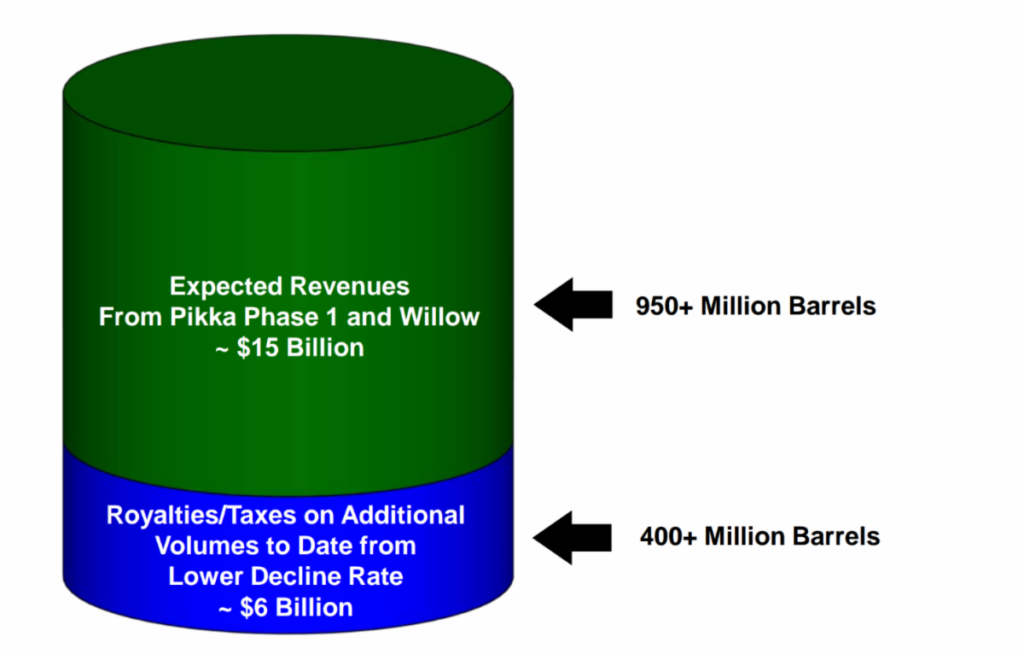
The production data since then tells a stark story. Under ACES, the decline rate ran at 5.8% per year. Under MAPA, it slowed to roughly 1% per year. The difference accounts for an estimated 433 million additional barrels of production that would not have materialized under the prior trajectory. Those barrels have generated approximately $6 billion in royalties and taxes flowing to the state, municipalities, and Alaska landowners.
And that figure does not include what’s coming. The Department of Revenue estimates that Pikka Phase 1 and Willow alone will deliver roughly $15 billion in revenues to the state treasury over their productive lives, from more than 950 million barrels. These are projects, Pulliam emphasized, that would not have been economic under the old system.
Joe Balash, an AOGA board member alternate who served in the Parnell administration and helped architect SB 21 before joining the private sector, provided additional context on the legislative effort behind the reform. The process involved 56 hearings, the longest of which ran thirteen and a half hours, along with months of economic modeling comparing investment performance across jurisdictions and project types. Balash noted that 57% of the current legislature has been seated since 2020, and only nine members voted on SB 21 in 2013. Most of those nine voted no.
“There is no institutional memory about why the change was necessary,” Balash observed.
The Competitiveness Problem
Pulliam’s data on comparative tax rates placed Alaska’s position in sharp relief.
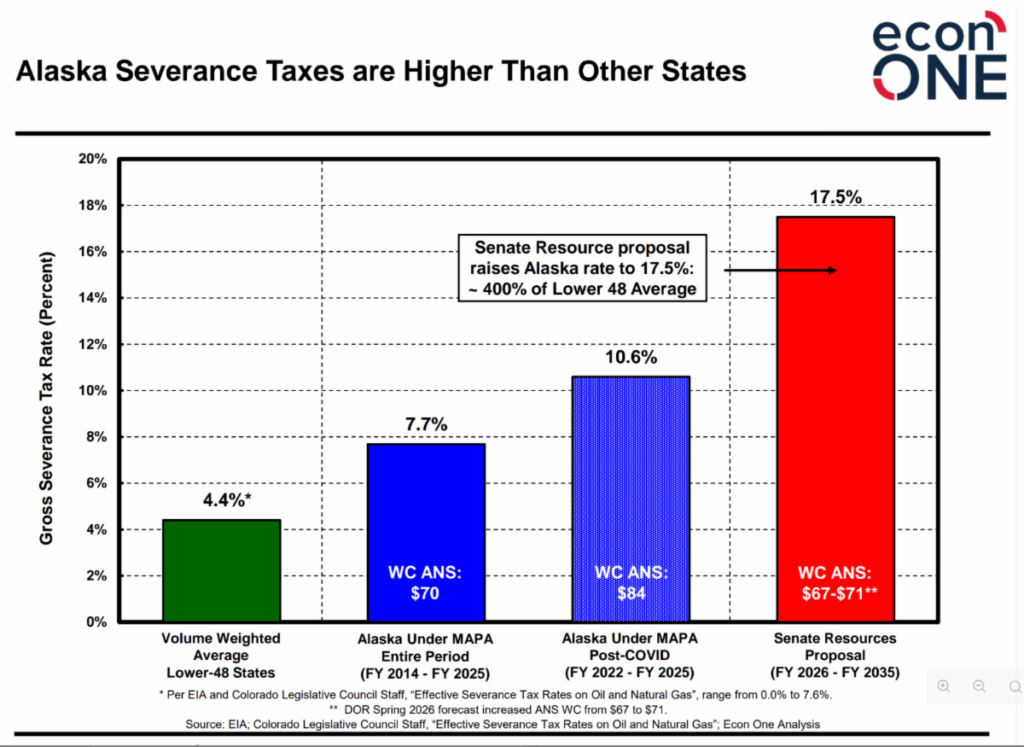
The volume-weighted average gross severance tax rate across Lower 48 oil-producing states is 4.4%, with individual state rates ranging from 0% to 7.6%. Under MAPA over its full history (FY 2014–2025), Alaska’s effective rate has averaged 7.7%, already nearly double the national figure. In the post-COVID period (FY 2022–2025), with ANS West Coast prices averaging $84 per barrel, Alaska’s effective rate climbed to 10.6%.
The Senate Resources proposal under SB 227 would push the rate to 17.5%.
That’s roughly four times the Lower 48 average. And it comes layered on top of the highest corporate income tax rate among major oil-producing states. Alaska’s 9.4% corporate income tax exceeds California’s 8.8% and dwarfs the zero percent charged by Texas and Wyoming, which together account for well over half of domestic production.
Pulliam noted that the proposed 17.5% gross rate is equivalent to what the effective tax rate under the old ACES system would have yielded at roughly $100 per barrel. At prices below that threshold, the Senate Resources proposal would actually produce higher taxes than even ACES did. In the short term, the bill would generate more revenue for the state at lower prices than the current system, but only if you assume no impact on production. That assumption, Pulliam cautioned, holds only briefly. Over time, the higher burden would discourage the very investment that sustains volume. The Department of Revenue’s own fiscal note on the bill concluded that under either the fall or spring price forecast, every field on the North Slope would be operating at a loss under the proposed rate.
The Stability Premium
Forum participants pressed Pulliam on whether a single tax rate differential drives investment decisions. His answer was more nuanced than a simple threshold.
The tax rate matters, he acknowledged, but what may matter more is the expectation that the rate will change. Texas has maintained its top severance rate of 4.6% since 1951. That kind of stability has compounding value for companies evaluating long-cycle investments like the ones Alaska depends on.
The timeline in Alaska looks very different. Producers who committed more than $14 billion to Pikka and Willow based on the fiscal terms in place under MAPA are now watching the legislature consider a regime change before those projects have reached full production. Pulliam described the dynamic bluntly: investors who committed capital under one set of rules are now facing the prospect of a different set, and the word he used for that was “bait and switch.”
Several participants thought SB 227 was unlikely to pass this session. Even so, the fact that it came out of Senate Resources at all raises the risk profile for future investment. Every project evaluation model includes a political risk factor. When a major committee moves a bill that would quadruple the tax rate relative to competing jurisdictions, that factor adjusts upward, and it does not quickly come back down.
Pulliam, who has done consulting work in Venezuela and other volatile fiscal jurisdictions, drew a pointed comparison. During the ACES period, he said, Alaska’s reputation among global investors began to resemble that of regimes not typically considered peers. The decade under MAPA rebuilt credibility. The question now is whether the state is prepared to spend that credibility again.
The Long Game
The conversation returned repeatedly to a tension that sits at the center of Alaska’s fiscal debate: the gap between what production contributes and what the public perceives.
Production volumes are rising, but revenues are not increasing proportionally. That gap reflects lower forecast prices, the gross revenue exclusion period for new projects, and the fact that Pikka and Willow are still in their earliest, lowest-revenue years. Balash noted that viewers looking at a ten-year revenue window are seeing the nose of the camel, not the full animal. Pikka Phase 1 alone is projected to contribute roughly $250 million to the state treasury in FY 2027, mostly from royalties. As the GVR period expires and production matures, that figure climbs past $300 million annually at the same price assumptions.
The business opportunity ahead extends well beyond the projects already committed. The pipeline of potential development is substantial: Pikka Phase 2, Qugruk, Horseshoe, Sockeye. But each of those projects requires a final investment decision that will be informed, in part, by what the legislature does this year and next.
Alaska’s North Slope is not the Permian Basin. Wells do not come online in weeks. Pikka was discovered in 2013 and is only now approaching first oil, thirteen years later. Willow is approximately 50% through its development phase. The NPR-A lease sale just set records, a signal that companies see geological promise in Alaska’s rocks. But geological promise alone has never been sufficient. The fiscal and regulatory framework determines whether promise becomes production, and production becomes revenue.
The last decade suggests the current framework is working. The next decade will reveal whether Alaska lets it.
If you benefit from this information, join Commonwealth North as a member.
Reference Materials
- Alaska DNR, Fall 2025 Oil Production Forecast Presentation to Senate Finance Committee, January 22, 2026
- State of Alaska, Department of Revenue, Willow Project Fiscal Analysis – August 2025 Update
- State of Alaska, Department of Revenue, Pikka Project Fiscal Analysis – August 2025
- Source data: EIA; Colorado Legislative Council Staff, “Effective Severance Tax Rates on Oil and Natural Gas”; Tax Foundation; Econ One Analysis
This summary is a recap of the information presented. It is not an official record, transcript, or position statement. The content reflects only the views and statements made by the individual presenters and participants at the time of the forum. It should not be interpreted as representing the official views, opinions, policies, or positions of Commonwealth North, its leadership, board members, staff, or affiliates.